

Anesthesia Residency

Best Books, Apps and Tips for Anesthesia Residency by Dr. Jhanvi Bajaj

Estimated reading time: 5 minutes

Anesthesia residency is challenging, and keeping books, apps, and study timetables in sync is daunting. The Conceptual Anesthesia App has been developed to guide you along the way, providing a learning pathway from first-year residency through final exams and super speciality preparation.

Book Suggestions for Every Year of Residency
  1. First-Year Residency
  • For first-year residents, a good starting point is Lee’s Synopsis of Anesthesia, a short and easy-to-read book that helps with answering OT questions but is not sufficient for exams. 
  • This book provides a basic understanding of anesthesia.
  1. Second-Year Residency
  • Miller’s Anesthesia: This is also called the bible of Anesthesia, It is a standard reference book, but it is complex and difficult to memorize.
    • To make it more manageable, starting with systemic topics like neuro, respiratory, and cardiac anesthesia can be helpful. 
  • Morgan and Mikhail’s Clinical Anesthesiology: This is an alternative to Miller’s Anesthesia, it is simpler than Miller’s but more detailed than Lee’s.
    • This book presents information in a more understandable format and is useful for exam preparation.
Important Tips:
  •  Miller’s Anesthesia was useful for systemic topics like transplant, cardiac, neuro, and respiratory anesthesia but was not used directly for theory answers.
  • Referencing Miller’s Anesthesia in exams (MD, DNB, DA) impresses examiners.
  • A strategic study approach is to read Morgan and Mikhail’s for six months and make notes. Instead of writing extensive handwritten notes, highlighting key points, bookmarking, or using sticky notes can make revision easier.

Click here to learn more about the Anesthesia books: Conceptual Anesthesia Books

  1. Third Year Residency
  • Objective Anesthesia Review (ARC Book): This book Includes case presentations, explanations, instruments, and machines.
  • Yao and Artusio’s Anesthesiology: Comprehensive case presentation guide. Extra points from this book can be added to the ARC book.
  • Stoelting’s Anesthesia and Co-Existing Disease: Helpful for extra case-related questions.

Also Read: Best Anesthesia Resources: Guide for Indian Anesthesiologists

For Anesthesia Equipment:
  • Dorsch’s Anesthesia Equipment is detailed but difficult to remember.
  • Understanding Anesthestic Equipment & Procedure a Practical Approach by Dr. Baheti and Dr. Laheri: It is simpler and sufficient for exams.

Note: If you are too loaded with your training, thesis and studies the ARC book is the ultimate solution, it also covers equipment, but only enough to pass, not to excel.

For Anesthesia Pharmacology:
  • Stoelting’s Pharmacology and Physiology in Anesthetic Practice covers all anesthetic and related drugs comprehensively.
Subject-specific books for super speciality preparation or deeper understanding:

These are books not only for people who want to take NEET SS but also for those who want to understand the subject in a better way.

  • Neuroanesthesia: Cottrell and Patel’s Neuroanesthesia (comprehensive), if you don’t have the time you can for the shorter version of this book or Handbook of Neuroanesthesia (shorter).
  • Cardiac Anesthesia: Kaplan’s Cardiac Anesthesia, is well written, in detail yet easy to understand.
  • Pediatric Anesthesia: Gregory’s Textbook of Pediatric Anesthesia or Principles and Practice of Pediatric Anesthesia by Dr. Snehalatha and Dr. Nandini Dawe (simpler, Indian perspective).
  • Regional Anesthesia: 
    • Hadzic’s Textbook of Regional Anesthesia and Acute Pain Management– Well-structured with anatomy, sonoanatomy, block procedures, and key takeaways. Ideal for exam answers.
    • Herman Sehmbi’s (MCQs in Regional Anesthesia and Pain Therapy) – Essential for practising MCQs, especially for the regional anesthesia fellowship entrance exam at Ganga Hospital, Coimbatore.
    • Ganga Hospital Handbook – Summarized, well-organized, and useful for specific blocks. Covers:
  1. Indications
  2. Contraindications
  3. Anatomy
  4. Steps of the block
  5. Troubleshooting (complications & supplementary blocks)
YouTube Channels and Other Online Sources for Learning:
  1. NYSORA (New York School of Regional Anesthesia) – Best for regional anesthesia demonstrations (e.g., spinal anesthesia approaches).
  2. ISA Kerala (Indian Society of Anesthesiology, Kerala Chapter) – Offers case discussions and theory videos.
  3. Conceptual Anesthesia: Offers case discussions, theory videos and a detailed explanation of anesthesia topics.
Important Study Tips for Anesthesia Residency:
  1. Morning Schedule – Wake up 30–45 minutes before OT for revision.
  2. Post-OT Sleep Strategy – Take a 1.5-hour nap after OT to refresh before studying.
  3. Group Study – Discuss topics with peers after OT to stay consistent.
  4. Rotation-Specific Reading – Read relevant books during OT postings (e.g., Cottrell for neuroanesthesia, and Kaplan for cardiac).
Critical Care Books:
  1. Paul Marino’s ICU Book – Widely used by intensivists and DM critical care students.
  2. Washington Manual of Critical Care – Concise, easy-to-follow, and reproducible for exams.
Instagram Pages for Passive Learning:
  1. NYSORA Instagram Channel
  2. Follow Conceptual Anesthesia on Instagram for updates.
    • Provides videos, skill demonstrations, short notes, and quick revision material.
Conceptual Anesthesia App Overview:
  • Covers MD/DNB/DA exams and SS preparation.
  • Lectures are based on standard textbooks.
  • Live SS MCQ lectures by experienced faculty (DMs, DNBs, Fellows).
  • Sections included:
    • Instruments & Machines
    • Anesthesia Skills (with live videos)
    • DNB OSCEs (with answers)
    • Case Discussions (mock exams with consultants)
Books Included with Subscription:
  • Past 5 Years’ DNB Papers (Solved)
  • Drugs in Anesthesia
  • Short & Long Cases
  • Instruments & Machines
  • Critical Care
  • Upcoming Books: Systemic Anesthesia (Neuro, Pediatric, Cardiac, Airway)

Click here: Conceptual Anesthesia Books

Additional Perks of Conceptual Anesthesia:
  • YouTube Channel for in-depth video learning.
  • Instagram Channel for the latest updates and information.

Anesthesia residency can be tricky to balance with books, apps, and study schedules, but strategic learning and wise resources make it simple. Streamline your preparation with the Conceptual Anesthesia App, guided book suggestions, and online resources and ace your exams!

Also Read: Embracing the Future: Recent Advances in Anesthesiology

Click here to visit the Conceptual Anesthesia website to learn more about the platform and how it can help you during your residency.

Share

WhatsApp Image 2025-02-24 at 4.20.34 PM

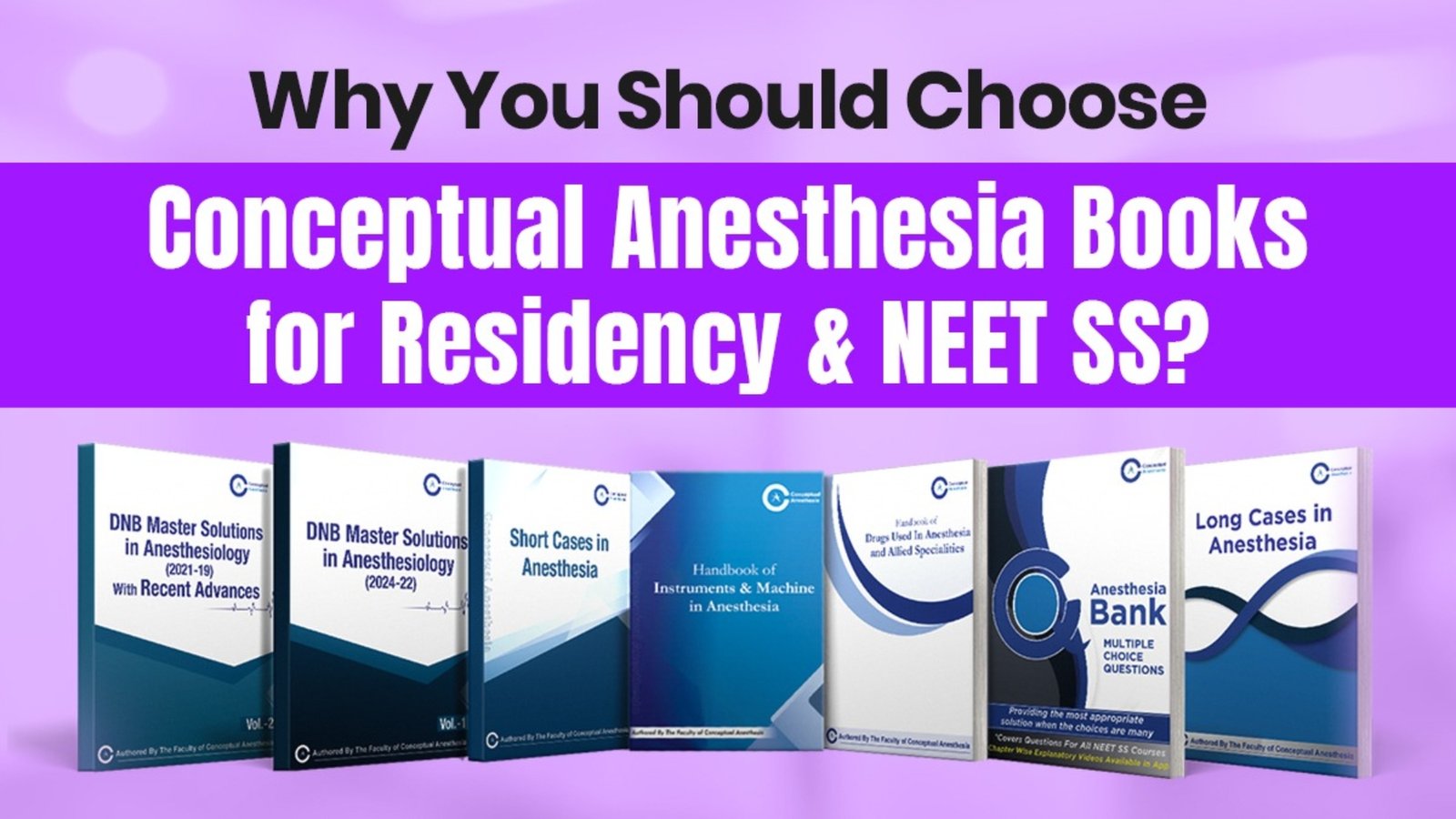
Why You Should Choose Conceptual Anesthesia Books for Residency and NEET SS?

Estimated reading time: 6 minutes

Anesthesia is a field that requires accuracy, in-depth knowledge, and a deep understanding of both theoretical and practical principles. Most of the resources available in the market either they are either unreliable or do not provide a methodical approach tailored to postgraduate students and working anesthesiologists.

Conceptual Anesthesia books fill this gap with meticulously designed content that caters to MD, DNB, and DA students while also serving as a comprehensive reference for experienced practitioners. In this blog, we explore why these books stand out from the available study materials and why every anesthesiology student should purchase them.

1. Handbook of Drugs Used in Anesthesia & Allied Specialties(for MD/DNB/DA Theory & Practical Exam Preparation)
What Makes This Book Unique?
  • Offers a comprehensive categorization of anesthetic medications by the mechanism of action, pharmacokinetics, pharmacodynamics, and side effects.
  • This textbook concentrates exclusively on anesthesiology and critical care for focused learning.
  • Organized in a clear manner that simplifies drug knowledge and its application to medical practice.
  • Necessary for postgraduate students require detailed information for examinations and practitioners require an accessible, instant reference.
How Does it Stand Compared to Other Market Resources?
  • Focused more on anesthesia-specific medications than general pharmacology texts.
  • Has a clear and organized structure compared to most drug books in which drugs are given without proper description.
  • Made for ease of practical use, as opposed to theory-oriented resources.
Click Here to Check the Sample
2. Handbook of Instruments & Machine in Anesthesia (for MD/DNB/DA Theory & Practical Exam Preparation)
What Makes This Book Unique?
  • Provides a comprehensive review of all major anesthetic instruments, such as endotracheal tubes, LMAs, laryngoscopes, and regional anesthesia equipment.
  • Well-illustrated with high-quality photographs and diagrams, facilitating visual learning and identification.
  • It breaks down complex ideas into simple terms and uses clear pictures to show how everything works.
  • Gives step-by-step instructions on the application and working of each instrument, which is hardly discussed in such detail in other anesthesia books.
How Does it Stand Compared to Other Market Resources?
  • In contrast to books on general surgical instruments, this one is exclusively devoted to machines and tools of anaesthesia-related devices.
  • While most resources mention instruments very little, this one has thorough explanations with a clinical perspective.
  • A necessity for exam prep as well as everyday knowledge.
Click Here to Check the Sample
3. Anesthesia Q Bank – Multiple Choice Questions for NEET SS/MD/DNB Preparation
What Makes This Book Unique?
  • Contains an exhaustive set of high-yield MCQs designed for NEET SS/MD/DNB exams.
  • Created not just for self-analysing but also for understanding concepts, with in-depth explanations for every question.
  • Mimics actual exam patterns, so that you can overcome the exam pressure.
How Does it Stand Compared to Other Market Resources?
  • Whereas most MCQ books simply offer answers, this book has explanations that increase conceptual clarity.
  • Covers all relevant topics with a systematic approach, as opposed to random question collections found in the market.
  • Specifically focused on anesthesia and not a general medical MCQ book.
Click Here to Check the Sample
4. Long Cases in Anesthesia (for MD/DNB/DA Practical Exam Preparation)
What Makes This Book Unique?
  • Offers a systematic approach to long case presentations so that students learn to present and analyze cases effectively.
  • Comprises diagrams, tables, and logical dissections of complicated cases to improve understanding.
  • Bridges the theoretical learning and practical clinical decision-making gap.
How Does It Stand Out Among Other Market Resources?
  • Unlike other textbooks, which place greater emphasis on theory, this book stresses practical case-based learning.
  • Provides a clear-cut roadmap for solving long cases, something that is not present in other anesthesia books.
  • Specifically tailored for postgraduate practical exam preparation.
Click Here to Check the Sample
5. Short Cases in Anesthesia (for MD/DNB/DA Practical Exam Preparation)
What Makes This Book Unique?
  • Covers common short cases in anesthesia exams with clear and organized explanations.
  • Assists students in gaining confidence during viva sessions and actual clinical discussions.
  • Emphasizes the building of clinical reasoning skills over mere rote memorization.
How does It compare to Other Market Resources?
  • Different from theoretical textbooks, this book exclusively deals with practical shortcases.
  • Provides an organized learning strategy, which makes it better than scattered or disorganized resources.
  • Serves as a perfect bridge between knowing and applying, making the student exam-prepared.
Click Here to Check the Sample
6. DNB Master Solutions in Anesthesiology (2024-22) Vol. 1
Why This Book Is a Must For DNB/MD Students?
  • Cover DNB last year’s paper from 2022 to 2024, with detailed explanations.
  • A highly methodical textbook to approach DNB anesthesiology exams with a focus on current examination trends.
  • Applies theoretical principles to real practice, thus bridging knowledge gaps more satisfactorily.
  • Comprehensive covering of vast amounts of case presentations and questions suited to the existing examination pattern.
How does It compare to Other Market Resources?
  • In contrast to generic textbooks, which are more generic, this one is exam-centered.
  • Created for exam prep and practical use, so it is more useful than other texts.
  • Incorporates a current methodology in training for anesthesia, including new advancements made in the discipline.
Click Here to Check the Sample
7. DNB Master Solutions in Anesthesiology (2021-19) with Recent Advances Vol. 2
Why This Book Is a Must For DNB/MD Students?
  • Supplements Volume 1, covers DNB last year’s paper from 2019 to 2022, with detailed explanations.
  • Emerging trends and the latest developments in anesthesiology so that students remain abreast of the times.
  • Fills the gap between theoretical concepts and practical application in clinical practice.
How does It compare to Other Market Resources?
  • In contrast to old resources that fail to account for recent developments, this book makes students aware of the most up-to-date guidelines and methods.
  • A worthy supplement for anyone seeking to deepen their knowledge of modern anesthesia practice.
Click Here to Check the Sample

How to purchase these books?

The books are not available from bookstores or online websites. They are exclusive and are available only with a premium subscription to Conceptual Anesthesia. A combined learning package integrating structured books, expert online lectures, and interactive case discussions. This specially curated collection offers detailed insights, case-based education, and systematic approaches that are essential for anesthesia residents and practitioners.

Subscribe to Conceptual Anesthesia Now!! And get access to these precious resources and revolutionize your anesthesia residency.

Conclusion

Conceptual Anesthesia books revolutionize learning anesthesiology by providing well-organized, exam-focused, and clinically applicable content. Contrary to textbooks that are vague, unstructured, or irrelevant to practice, Conceptual Anesthesia books deliver an effortless and effective learning process.

Also Read: Anesthesia Training Evolution: Shaping the Future of Modern Care

Whether you’re studying for theory, practicals, or super speciality entrance exams, Conceptual Anesthesia App will grant you an unparalleled edge. Spend in the finest study aids and start heading down the success road with Conceptual Anesthesia books!

Share

anesthesia residents

The Road to Success for the Anesthesia Resident: Tips and Resources to Thrive in Anesthesia Residency

Estimated reading time: 4 minutes

Embarking on Anesthesia Residency is a very exhilarating journey filled with opportunities to develop essential clinical skills and build up a strong career. This is whether you find yourself at the start of your anesthesia training program or in the final years. Here, you’ll find tips and resources for anesthesia residents to thrive both in training and practice. Being part of one of the best anesthesia residencies can set up to prosper and flourish by following these key strategies.

1. Adopt a behaviour toward continuous learning

Anesthesiology is a dynamic field, and one has to keep updating oneself on current practices. Engage in case discussions, attend workshops, and make use of online material. Specialized resources, like Conceptual Anesthesia, give anesthesia residents the opportunity to boost their knowledge and expertise in a structured manner. A dedicated learner is sure to be ready for real-world challenges.

2. Develop Practical Skills Early

Practical skills are of much importance in anesthesia residencies. Develop a routine for regular simulator practice, if such facilities are available, seek feedback from the mentors on intubation, monitoring, pain control etc. The most successful anesthesiology residency programmes usually consider practical training early in their courses, because the theoretical knowledge should correspond to clinical practices as much as possible.

3. Effective Communication Ends

Anesthesia residents need strong communication skills for collaboration with the surgeon, nurse, and patient. Good practice of clear, concise communication may help to improve patient outcomes and ensure a safe work environment. Even though the training programs in anesthesiology that stress teamwork provide an advantage, practice and feedback can enhance skills for all residents.

4. Prioritize Self-Care and Well-Being

Anesthesia residency can be pretty demanding both physically and mentally. During your anesthesia residency, make sure to sleep well, exercise regularly, and look after your mental health. Residency is extremely intense, but good health will make you tougher, sharper, and capable of keeping up with day-to-day responsibilities in high-stakes settings.

Also Read: Emerging Technologies and Innovative Methods in Anesthesia  Residency Program

5. Find a Mentor and Seek Guidance

Mentorship is invaluable in any anesthesiology residency. Be able to connect with experienced anesthesiologists who can give you some insights on how to manoeuvre challenges in the field. The best anesthesia residency often includes mentorship programs that will help residents gain confidence and learn from experienced practitioners.

6. Make the Most Use of Available Resources

Resources designed based on requirements of the anesthesia residency, programs such as Conceptual Anesthesia provide live lectures and recorded videos or case-based discussion of what goes wrong and ways in demonstrations for practice with full capabilities that would facilitate a transition of support after training.

7. Foster Professional Connections

Building a professional network is an important part of anesthesia residency. Conferences, resident groups, and peers at all anesthesiology programs are valuable connections to be made during the residency, often providing future job opportunities, research collaborations, and networks.

8. Stay Organised and Keep Learning Goals in Focus

A good track of your progress, setting achievable goals on learning, and maintaining a journal can truly make the difference in how well you are developed in anesthesia residency. Reflection on challenges and achievements will help develop a well-rounded skill set while ensuring both personal and professional milestones are met.

Also Read: 10 Trends Every Anesthesiologist Should Know: Revolutionizing Anesthesia

Conclusion:

The anesthesia residency path is demanding and incredibly satisfying. Focusing on continual learning, skills-building, and professionalism along the path will ensure success for the resident. At Conceptual Anesthesia, all the necessary tools and support are available to lay that base of knowledge you’ll need during anesthesia residency.

Get ready to shine in anesthesiology residency. Join Conceptual Anesthesia App to kick off the beginning of achieving a rewarding career in the field of health care.

Share