
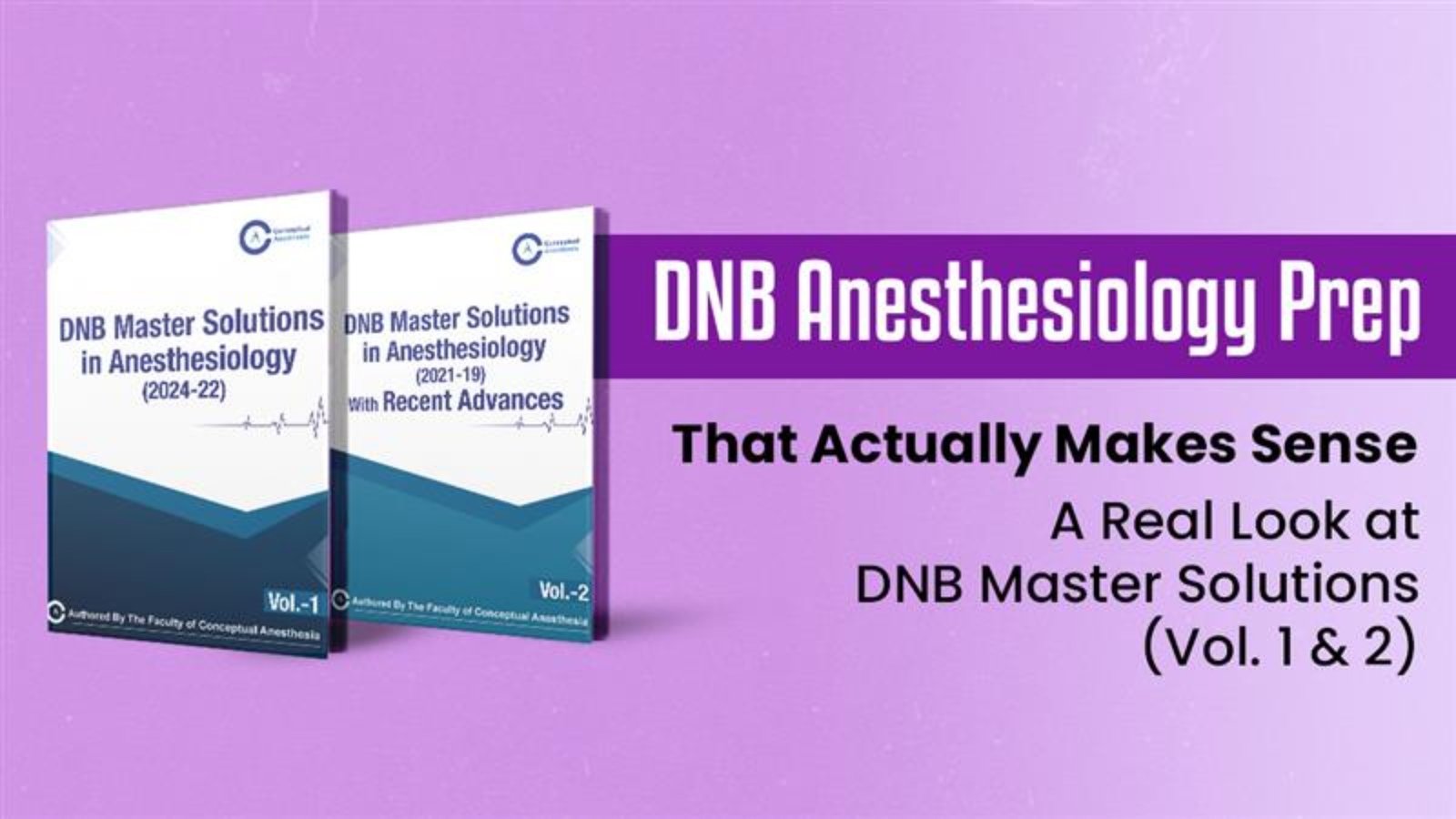
DNB Master Solutions (Vol. 1 & 2)

DNB Anesthesiology Prep That Actually Makes Sense: A Real Look at DNB Master Solutions (Vol. 1 & 2) 

Estimated reading time: 5 minutes

If you’ve spent even a few weeks in Anesthesia residency, you already know this—just reading standard anesthesia books isn’t enough. You go through topics, revise them, maybe even feel confident for a while, but when it comes to writing in the DNB theory exam or structuring answers in the MD Exam or DA Exam, things don’t come out the way you expect. 

That gap is real. And that’s exactly where DNB Master Solutions in Anesthesiology – Volume 1 & Volume 2 by the faculty of Conceptual Anesthesdia start to feel useful—not as another source of study material, but as something that actually helps with exam preparation. 

Volume 1: Recent Papers, Current Pattern (2024–2022) 

Starting with Volume 1—this one feels closest to the actual DNB exam you’re preparing for. 

It covers recent years (2024–22), and you can see the difference. The pattern, the integration, the way questions are asked—it all feels relevant to the current DNB theory format. 

What stands out while using it: 

  • Questions reflect what you’re likely to see in the DNB theory exam  
  • Answers are structured in a way you can reproduce in real exams  
  • It pushes you toward clinical thinking, not just memorization  

If you’re also preparing alongside NEET SS anesthesia or planning ahead for NEET SS exam, this volume aligns well with that level of thinking. 

It’s not complicated reading. You go through an answer once, and it makes sense. That helps more than people realize during heavy neet ss preparation phases. 

Volume 2: Building Depth + Recent Advances (2021–2019) 

Now Volume 2—this one goes a bit older (2021–19), but it plays a different role. 

It helps you slow down a bit and actually understand things properly, especially if you’re early in your anesthesia residency or still figuring out how to approach the DNB theory exam. 

What you’ll notice here: 

  • Slightly more space to build concepts  
  • Better for getting comfortable with answer writing  
  • Includes relevant recent advances without overloading  

For many anesthesia residents, this becomes the starting point. It’s not rushed, and that helps when your base isn’t fully solid yet. 

How to Use These Books? (Without Overcomplicating It) 

Most people try to “complete” books like this. That usually doesn’t work. 

A more practical way: 

  • Try answering first—even if it’s incomplete  
  • Then read the solution and compare  
  • Focus on what you missed (structure matters as much as content)  

Also, don’t ignore timing. Occasionally solving under exam conditions helps with the DNB exam mindset. 

And revision? That’s where this really pays off. The second or third read feels much faster and clearer. 

What Actually Improves Over Time?

If you use both volumes consistently, a few things start changing—not suddenly, but steadily: 

  • Your answers become more structured  
  • You stop writing unnecessary details  
  • You recognize repeated themes across DNB theory and even NEET ss exam patterns  
  • You feel less stuck during long answers  

It’s subtle, but it builds confidence. 

Volume 1 vs Volume 2 — Keep It Simple 

If you’re unsure where to begin, keep it straightforward. 

Start with Volume 1. It reflects the most recent DNB theory exam pattern, so you get used to how questions are currently framed and what the exam expects from your answers. 

Once you’re comfortable with that, move to Volume 2. This helps reinforce your base, gives you more practice with slightly older questions, and strengthens your overall understanding without the pressure of “latest trends.” 

You can examine the sample pages here to quickly obtain a sense of the format, clarity, and question style of both DNB Master Solutions in Anesthesia Volumes 1 and Anesthesia volume 2. 

Final Thought 

Whether it’s the DNB theory exam, MD Exam, DA Exam, or even future NEET SS preparation, the challenge is the same—you need to convert knowledge into answers that score. 

DNB Master Solutions in Anesthesiology – Volume 1 & Volume 2 don’t try to replace your main study material. But they do something equally important—they show you how to apply what you’ve studied. 

And for most anesthesia residents, that’s the part that makes the real difference.

Share

Anesthesia Residents

How to Approach Residency with Confidence and Clarity? 

Estimated reading time: 7 minutes

Residency is not just the next step after MBBS. It is the phase that quietly shapes the next 30–40 years of your professional life. 

During MBBS, life had structure. Lectures, breaks, exams, some late nights, some fun. Even internship, though busy, does not fully prepare you for what residency demands. Residency is different. It is intense, immersive, and deeply transformative. 

If you approach it with clarity and intention, it can become the strongest foundation of your career. If you drift through it, you may spend years trying to fill the gaps later. 

1. Let the Change Sink In 

The first thing you must accept: your life is going to change completely. 

Residency is not a continuation of student life. It is professional life. 

  • You cannot be late. 
  • You cannot “bunk” responsibilities. 
  • You cannot afford to be casual. 
  • You cannot party at 3 AM and expect to function well at 8 AM in the OT. 

If OT starts at 8, you should be ready before 8. Not walking in at 8:05 while induction has already begun. 

If you are posted in anesthesia: 

  • See the patient pre-operatively. 
  • Know the PAC findings. 
  • Be aware of hemoglobin, electrolytes, comorbidities. 
  • Anticipate complications. 
  • Prepare your OT setup in advance. 

Even better — discuss the next day’s case with your consultant: 

  • Should an arterial line be kept ready? 
  • Is a central line anticipated? 
  • Which infusions might be required? 

Preparation changes everything. When consultants see that you are organized and invested, they are far more inclined to teach you, guide you, and trust you with procedures. 

2. Build a Sustainable Routine 

Residency is long-term. You cannot survive it on adrenaline alone. 

Morning Matters 

Do not wake up at the last minute and rush. Even 15 extra minutes to: 

  • Eat properly 
  • Sit calmly 
  • Begin your day intentionally 

…can change your mental state for the entire day. 

Food Is Fuel, Not a Coping Mechanism 

Avoid: 

  • Constant outside food 
  • Skipping meals 
  • Decision fatigue over what to order daily 

Have something predictable and healthy. A fixed dinner option is often better than spending 30 minutes choosing from delivery apps. 

Poor nutrition leads to: 

  • Brain fog 
  • Irritability 
  • Fatigue 
  • Reduced performance 

And in anesthesia, performance matters. 

Sleep Is Precious 

On non-call days, aim for 4–6 hours of uninterrupted sleep at minimum. Doom scrolling at night may feel like relaxation, but it steals recovery. 

Your mind and reflexes need rest. 

3. Study From Day One (But Be Realistic) 

You will not be able to study for 3–4 hours daily. That expectation is unrealistic. 

Instead: 

  • Watch one 20–30 minute video daily. 
  • Revise the case you are seeing the next day. 
  • Read short, focused topics. 

If tomorrow’s case is TURP, revise TURP anesthesia. 
If it’s Whipple’s procedure, read about its anesthetic concerns. 

When you: 

  1. Study the topic briefly, and 
  1. See it live in OT the next day 

…it becomes permanently etched in memory. 

The days feel long in residency. The years pass quickly. If you postpone studying for “later,” later arrives very fast. 

4. Don’t Be Invisible — Don’t Be Overzealous 

Some residents: 

  • Stand quietly for three years. 
  • Never ask questions. 
  • Never participate. 
  • Graduate without consultants remembering their name. 

Others: 

  • Fight for every case. 
  • Try to control everything. 
  • Appear pushy or competitive. 

Neither extreme helps. 

Be present. Speak up. Participate in discussions. Ask doubts. Answer when questioned. 

At the same time, understand teamwork. You are part of: 

  • Consultants 
  • Senior residents 
  • Junior residents 
  • OT staff 
  • Nursing team 

Medicine is never an individual performance. 

5. Respect Everyone — Not Just Consultants 

Respect: 

  • Second- and third-year residents. 
  • OT staff. 
  • Nurses. 
  • Technicians. 
  • Support staff. 

They may have decades of experience in the OT. Your degree does not automatically make you superior. 

Your seniors also influence: 

  • Emergency exposure 
  • Procedural opportunities 
  • Learning environment 
  • Thesis guidance 

Respect builds support. Arrogance isolates. 

6. Stay Away from Gossip 

Anesthesia often has breaks during long cases. Conversations happen. Gossip happens. 

Be careful. 

Small comments can: 

  • Be misquoted. 
  • Be exaggerated. 
  • Damage your reputation. 

Someone who gossips about others may gossip about you. 

If uncomfortable: 

  • Change the topic. 
  • Stay neutral. 
  • Avoid adding fuel. 

A peaceful residency is far more valuable than temporary entertainment. 

7. Whatever Is Yours Will Come to You 

You may not get every spinal. 
You may miss a central line. 
You may feel someone else is getting more opportunities. 

Over three years, exposure balances out. 

Focus on: 

  • Learning properly. 
  • Understanding the reasoning behind procedures. 
  • Knowing when to persist — and when to change strategy. 

Skill is not about the number of attempts. It is about judgment. 

8. Finish Your Thesis Early 

One of the biggest stressors in final year is an incomplete thesis. 

From the first month: 

  • Finalize topic quickly. 
  • Begin data collection early. 
  • Push for timely approvals. 
  • Work steadily. 

If your thesis is submitted early, your mind becomes free for exam preparation. 

If it drags into the last few months, it competes with your revision — and drains your energy. 

9. Make Mistakes. Speak Anyway

When consultants ask questions: 

  • Try to answer. 
  • Even if imperfect. 
  • Even if partially correct. 

Silence does not earn marks in exams. Expression does. 

During vivas: 

  • Structured answers are ideal. 
  • Imperfect but attempted answers still earn marks. 
  • Silence earns nothing. 

Build the habit of articulating your thoughts during residency. 

Case discussions, seminars, presentations — these are practice grounds. 

10. Build the Right Habits Early 

During residency, shortcuts are tempting: 

  • Skipping proper sterile precautions. 
  • Ignoring gloves. 
  • Being casual with protocol. 
  • Speaking harshly to staff. 
  • Cutting corners because “no one is watching.” 

Habits formed now will follow you into corporate hospitals and private practice. 

Today’s healthcare system observes: 

  • Sterility 
  • Etiquette 
  • Communication 
  • Professional conduct 

Clinical excellence alone is not enough. Professional behavior matters just as much. 

Build the foundation properly. 

A Word About Conceptual Anesthesia 

The journey of eConceptual began with a simple idea — that Indian postgraduate students deserve structured, high-quality, experience-driven learning built by Indian teachers. 

From conceptual orthopedics to surgery and now anesthesia, the aim has been to preserve practical wisdom and organize it into: 

  • Comprehensive video lectures 
  • Structured notes and books 
  • MCQs with video explanations 
  • OSCE preparation 
  • Live academic sessions 

Conceptual Anesthesia was built with a complete structure from the start — covering academics, clinical application, exam preparation, and super-specialty content. 

It reflects one core belief: residency is not just about passing exams. It is about becoming competent, confident, and ethical in patient care. 

Final Thoughts 

Residency will test you: 

  • Physically 
  • Mentally 
  • Emotionally 

But it will also shape you. 

If you: 

  • Stay disciplined 
  • Study consistently (even in small amounts) 
  • Respect your team 
  • Avoid negativity 
  • Take care of your health 
  • Build correct habits 

…you will not just complete residency. You will emerge stronger, sharper, and more confident. 

These few years are the foundation of your entire career. 

Build it well. 

Share

FET Exam

How to Prepare for the FET Exam in One Month: A Conceptual Anesthesia Guide 

Estimated reading time: 5 minutes

You know FET Exam in just one month which can feel very intimidating, or especially when you are especially targeting a super-specialty way through FNB programs. However, if residents have the proper Preparation Strategy, with the strong conceptual clarity, and very well focused exam preparation, it will definitely possible to perform well in exams, although in FET Anesthesia, which has notable overlap with NEET SS Anesthesia and SS Anesthesia. 

This blog will provide a one-month FET Preparation roadmap especially for anesthesia aspirants, which is aligned with the fet syllabus, exam pattern, and real-world clinical application, while keeping FET 2026 in focus. 

Understanding the FET Examination 
What is the FET Exam? 

The FET examination is a national-level entrance examination which is conducted for admission into various FNB programs. The FET entrance examination tests your advanced clinical knowledge helps you in decision-making skills, and application-based understanding rather than factual recall. 

For anesthesia aspirants, the exam closely mirrors the overall conceptual depth, which is required for NEET SS, making it integrated preparation which is highly effective. 

FET Exam Pattern 

A thorough understanding of the exam pattern that is very important before planning your preparation. 

Key features of the FET 2026 exam pattern include: 

  • There will be the single paper with MCQs 
  • Predominantly clinical and scenario-based questions must be important 
  • Emphasis on peri-operative decision making 
  • Time-bound and high-pressure format 

You need to reviewing all the previous FET question papers and, when it will be available, the FET 2026 question paper helps to identify frequently that tested anesthesia concepts and exam trends. 

FET Syllabus for Anesthesia 

The fet syllabus for FET Anesthesia broadly covers: 

  • It covers all the core anesthesia principles 
  • It includes critical care and pain management 
  • Airway management and ventilatory strategies 
  • Peri-operative medicine and emergencies 

The syllabus sometimes overlaps notably with NEET SS Anesthesia, making concept-driven preparation highly efficient. 

One-Month FET Preparation Strategy for Conceptual Anesthesia 

as you know the time is limited, your focus must be shift from the exhaustive reading to important revision and application. 

Week 1: Strengthen Core Anesthesia Concepts 
  • You need to revise the important topics from SS Anesthesia 
  • Focus on the physiology-based anesthesia, pharmacology, and monitoring as well 
  • Always use concise, concept-oriented study material 
  • Please avoid switching between multiple sources 

Goal: Build clarity in concepts that are frequently tested in the FET Exam. 

Week 2: MCQs and Concept Integration 
  • For better clarity, solve previous FET question papers 
  • Practice all type of NEET SS-level anesthesia MCQs 
  • After each question, please thoroughly analyze the reasoning behind the correct and incorrect options 
  • Note weak areas for targeted revision 

This phase bridges theory with clinical application, critical for the FET entrance examination. 

Week 3: Exam Pattern Familiarity and Mock Tests 
  • Try comprehensive practices that are exams based on the format of the test.  
  • Adhere to the fundamentals of rigorous time management.  
  • Thoroughly examine all the errors rather than concentrating just on the ratings. 

By this stage, you should feel comfortable handling the pressure of the FET examination. 

Week 4: Final Revision and High-Yield Focus 
  • Only review previously covered material; and please avoid additional learning resources.  
  • Pay attention to the anesthetic crises and other which often test situations.  
  • Minimal MCQ for practice to keep the learning process continuous 
  • Do not learn every new subject at this time. 

Consistency and calmness are key in the final week. 

Top FET Preparation Tips for Anesthesia Aspirants 
  • Put cognitive clarity ahead of volume.  
  • Prepare for your exam in accordance with NEET SS and FET Anesthesia.  
  • Every day, even if just momentarily, just revise everything 
  • Examine each test and MCQ you take.  
  • Limit yourself to high-quality, limited study materials. 

These fet preparation tips are especially important when time is limited. 

Final Thoughts: Cracking FET 2026 with Conceptual Anesthesia 

It is difficult to prepare for FET 2026 in a single month, but it is unquestionably doable with careful planning and the correct attitude. Candidates who successfully apply the principles in all clinical circumstances and have a thorough understanding of them are rewarded by the FET Exam.  

You can increase your chances of passing this extremely competitive admission test by adhering to a concentrated preparation strategy, which includes understanding the FET 2026 exam format and aligning your study with NEET SS Anesthesia and SS Anesthesia. 

Stay focused, stay conceptual, and trust your preparation. 

Share