Estimated reading time: 6 minutes
Cracking a competitive exam is one thing. Securing Rank 1 is something else entirely.
And when that achievement comes during residency, while balancing OT duties, theory preparation, night calls, and exhaustion, it becomes even more impressive.
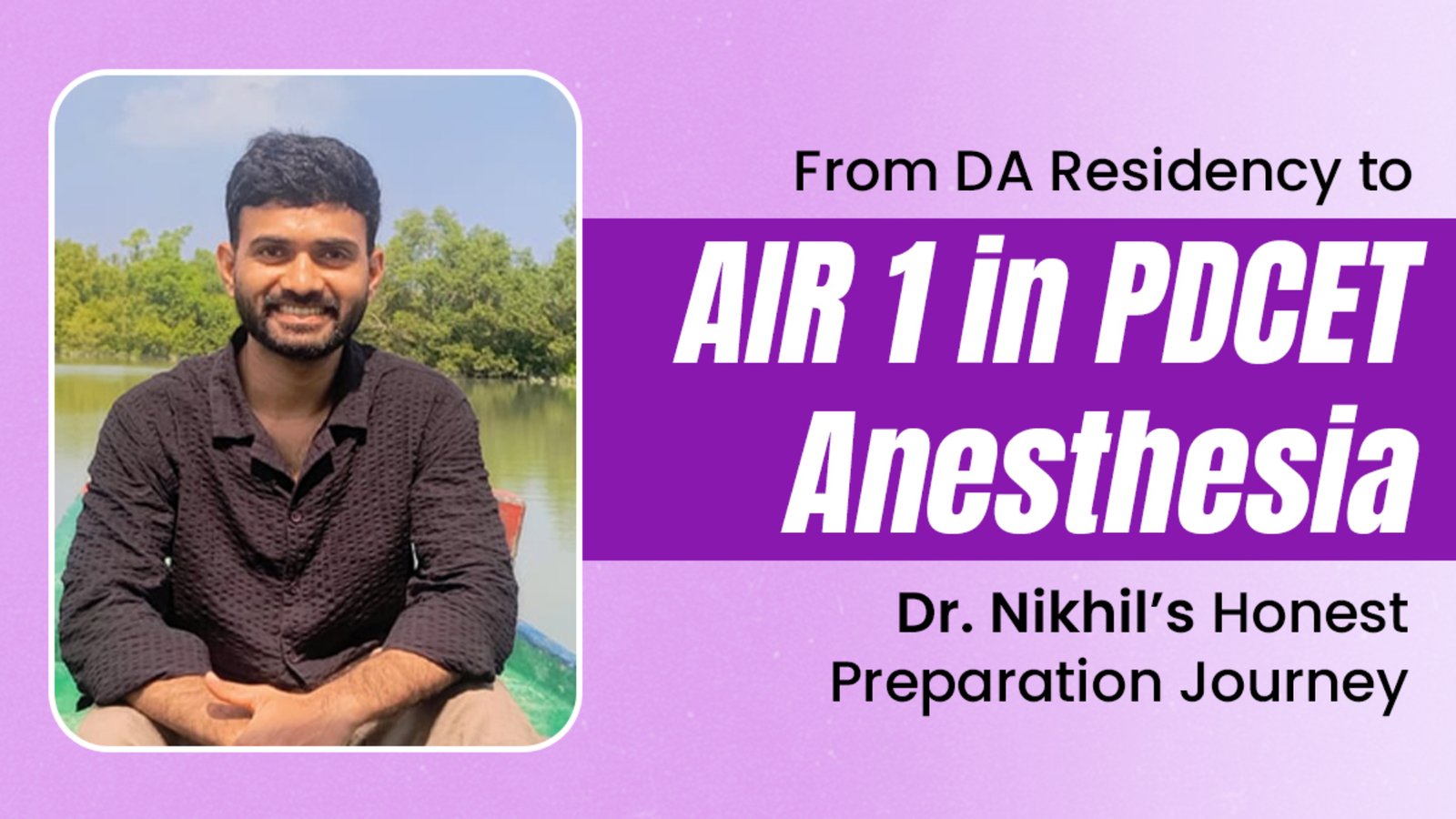
Dr. Nikhil recently secured AIR 1 in the PDCET Anesthesia exam, and what makes his journey interesting is how grounded and practical his preparation strategy actually was.
There was no dramatic “18-hour study routine.” No unrealistic productivity claims. No secret shortcut.
Instead, his preparation was built slowly over time through consistency, conceptual learning, and smart use of available resources.
A Strong Foundation Built During DA Residency
Dr. Nikhil completed his UG from B.J. Medical College, Pune, followed by his DA from Central Railway Hospital, SECR, Bilaspur.
Interestingly, he didn’t begin “serious” PDCET preparation just a few months before the exam. The groundwork had already started during his DA residency.
When he took admission into DA in 2023, he had already decided that he eventually wanted to pursue Secondary DNB through the PDCET route.
But instead of rushing into exam-specific preparation immediately, he focused first on building strong fundamentals.
And honestly, that decision seems to have made a huge difference later.
Residency Is Hectic — But Small Time Gaps Matter
Anyone who has gone through anesthesia residency understands how unpredictable the schedule can be.
Long OT hours. Emergency calls. Exhaustion after duty. And sometimes, after an entire day inside the OT, even opening a textbook feels difficult.
Dr. Nikhil spoke very honestly about this part.
He mentioned that although residency was busy, he still managed to find small pockets of time for studying from the first year itself. Instead of letting those gaps disappear into endless scrolling or passive downtime, he tried to use them productively whenever possible.
Not aggressively. Not perfectly. Just consistently.
That steady effort eventually compounded.
His Preparation Was More Conceptual Than Rote
One thing that stood out clearly in his preparation approach was the emphasis on conceptual understanding.
Rather than depending only on rapid revision notes or factual recall, he spent most of his residency strengthening theory.
The branches he had maximum exposure to during residency — OBS anesthesia, orthopedics, general surgery, and urology — were studied in depth from standard textbooks like:
- Barash,
- Morgan,
- Miller,
- and Tata.
Alongside that, he also prepared foundational subjects like:
- physiology,
- pharmacology,
- physics,
- and instruments
through conceptual resources used for Primary FRCA and MasterPass preparation.
That combination gave him both clinical understanding and theoretical depth.
How Conceptual Anesthesia Helped During Preparation?
Dr. Nikhil had subscribed to Conceptual Anesthesia during his first year of residency, and according to him, the platform became one of the major supports throughout his preparation journey.
His approach was simple but effective:
- Watch the conceptual videos first.
- Understand the topic clearly.
- Read the same topic from textbooks afterward.
- Consolidate and revise repeatedly.
That sequence helped bridge the gap between theory and application.
Instead of memorizing isolated information, he focused on understanding why things happen — which is becoming increasingly important in exams like PDCET and NEET SS.
Learning Even Inside the OT
One particularly relatable part of his journey was how he used smaller learning resources during residency itself.
He regularly studied from ATOTW (Anaesthesia Tutorial of the Week) by the World Federation of Societies of Anaesthesiologists.
According to him, those tutorials were:
- highly conceptual,
- easy to retain,
- and practical enough to connect directly with clinical work.
Sometimes he even used them during OT downtime.
That’s an important reminder for residents: preparation doesn’t always need massive uninterrupted study hours. Consistent learning in smaller sessions adds up more than people realize.
Smart Use of AI During the Last 30–40 Days
The most interesting part of Dr. Nikhil’s preparation was probably how he integrated AI tools into his final revision phase.
During the last 30–40 days before the exam, he started using Google Notebook LLM in a very targeted way.
Instead of relying on random internet-generated material, he uploaded authentic standard resources like:
- Miller,
- Morgan,
- and Washington Manual.
Using prompts, he generated customized topic-wise MCQs directly from those textbooks.
That meant:
- the question bank stayed source-based,
- concepts remained authentic,
- and revision became more personalized.
Rather than wasting time searching for scattered questions online, he created focused practice material based on the exact references he trusted.
Honestly, that’s a very smart way to use AI in medical preparation.
Solving MCQs Was Important — But Analysis Mattered More
Apart from the Conceptual Anesthesia Q-bank, he also revised through recorded NEET SS sessions.
But what helped most wasn’t just the volume of MCQs.
It was understanding difficult areas deeply and revisiting weak concepts repeatedly during the final week.
That approach becomes especially important now because modern anesthesia entrance exams are increasingly concept-based and clinically oriented.
The PDCET Anesthesia Paper Was Much Tougher Than Expected
One major insight from his interview was how different this year’s PDCET Anesthesia paper felt compared to what many candidates expected.
Traditionally, several students assumed the paper would stay close to the NEET PG level.
But according to Dr. Nikhil, this year’s exam was significantly more advanced.
He described it as moderate-to-difficult and much closer to NEET SS style preparation.
Critical Care Dominated the Paper
One of the biggest surprises was the heavy focus on critical care medicine.
Around 30–40 questions reportedly came from critical care, and many of them were:
- lengthy,
- scenario-based,
- and clinically applied.
The paper also included important topics like:
- difficult airway algorithms,
- airway management,
- updated CPR guidelines for 2025,
- and applied clinical anesthesia scenarios.
This shift clearly suggests that future PDCET preparation may need:
- stronger conceptual clarity,
- better clinical integration,
- and deeper understanding beyond standard NEET PG preparation alone.
Why His Journey Feels So Relatable?
What makes Dr. Nikhil’s story genuinely motivating is that it doesn’t sound unrealistic.
He didn’t claim perfection.
He admitted residency was tiring. He acknowledged that distractions exist. He openly spoke about confusion regarding future choices and superspecialist plans.
But through all of that, he kept building steadily.
And that consistency eventually translated into AIR 1.
A Reminder for Every Resident Preparing for Competitive Exams
There’s something important residents can learn from this journey.
You don’t always need:
- extreme study schedules,
- endless resources,
- or constant panic preparation.
Sometimes, strong basics built over time matter more.
A few focused hours daily during residency, conceptual understanding, smart revision strategies, and honest consistency can take you much further than last-minute cramming alone.
And Dr. Nikhil’s AIR 1 result is probably one of the best examples of that.