
NEET SS Preparation in 60 days

2 Months Remaining for NEET SS: How to Prepare in the Last 60 Days? 

Estimated reading time: 3 minutes

Two months to go for NEET SS. From here, your time should go into revision, MCQs, mock tests and fixing the areas where you’re weak. 

Don’t add new resources now. What matters is that you can recall and apply what you’ve already studied when you’re sitting in the exam. 

1. Focus on Revision 

Revise in an organised way, starting with the topics that matter most: 

  • High-yield topics 
  • Concepts that are asked often 
  • Clinical correlations 
  • Your weak areas 
  • Topics you keep forgetting 

Don’t just reread. Test yourself as you go, so the revision actually sticks. 

2. Solve MCQs Every Day 

Make MCQs a daily habit in these last weeks. After each question, work out why the right option is right and why the others are wrong. That builds your concepts and your question-solving at the same time. 

3. Give Regular Mock Tests 

Take GTs regularly to see where you stand and which mistakes keep repeating. After each test, go through: 

  • Wrong answers 
  • Guessed answers 
  • Questions that ate up your time 
  • Mistakes you’ve made before 
  • Weak topics 

Going through the test matters as much as taking it. 

4. Keep Your Resources Limited 

Stop jumping between books, videos and question banks. Choose your main resources, then finish them, revise from them and test yourself on them. 

Month 1: Focused revision, MCQs, and finding your weak areas 

Month 2: More GTs, targeted revision, revising your mistakes, and high-yield topics 

Final Week: Stay with your short revision material. Don’t start anything big or new. 

If you’re preparing for NEET SS Anesthesia, Conceptual Anesthesia offers a set of 11 books. It covers MCQs, clinical cases, airway, cardiac anesthesia, drugs, instruments, Golden Topics and DNB Master Solutions. 

The set includes: 

  • Anesthesia Bank – MCQs 
  • Long & Short Cases in Anesthesia 
  • Cardiac Anesthesia 
  • Anesthesia Airway 
  • Golden Topics in Anesthesia 
  • DNB Master Solutions 
  • Drugs, Instruments & Machines in Anesthesia 

See the complete 11-book set here: 
Conceptual Anesthesia – Set of All Books 

If you want to tighten up your Anesthesia preparation in these last two months, now is the time to narrow your focus. Get ₹12,000 OFF on Anesthesia with Conceptual Anesthesia. 

Two months is still enough to make a real difference if you use it well. 

Revise. Solve more MCQs. Go through your tests. Work on your weak areas. Then do it all again. 

You don’t need to study everything again. You need to remember what you’ve already studied when the exam comes.  

Share

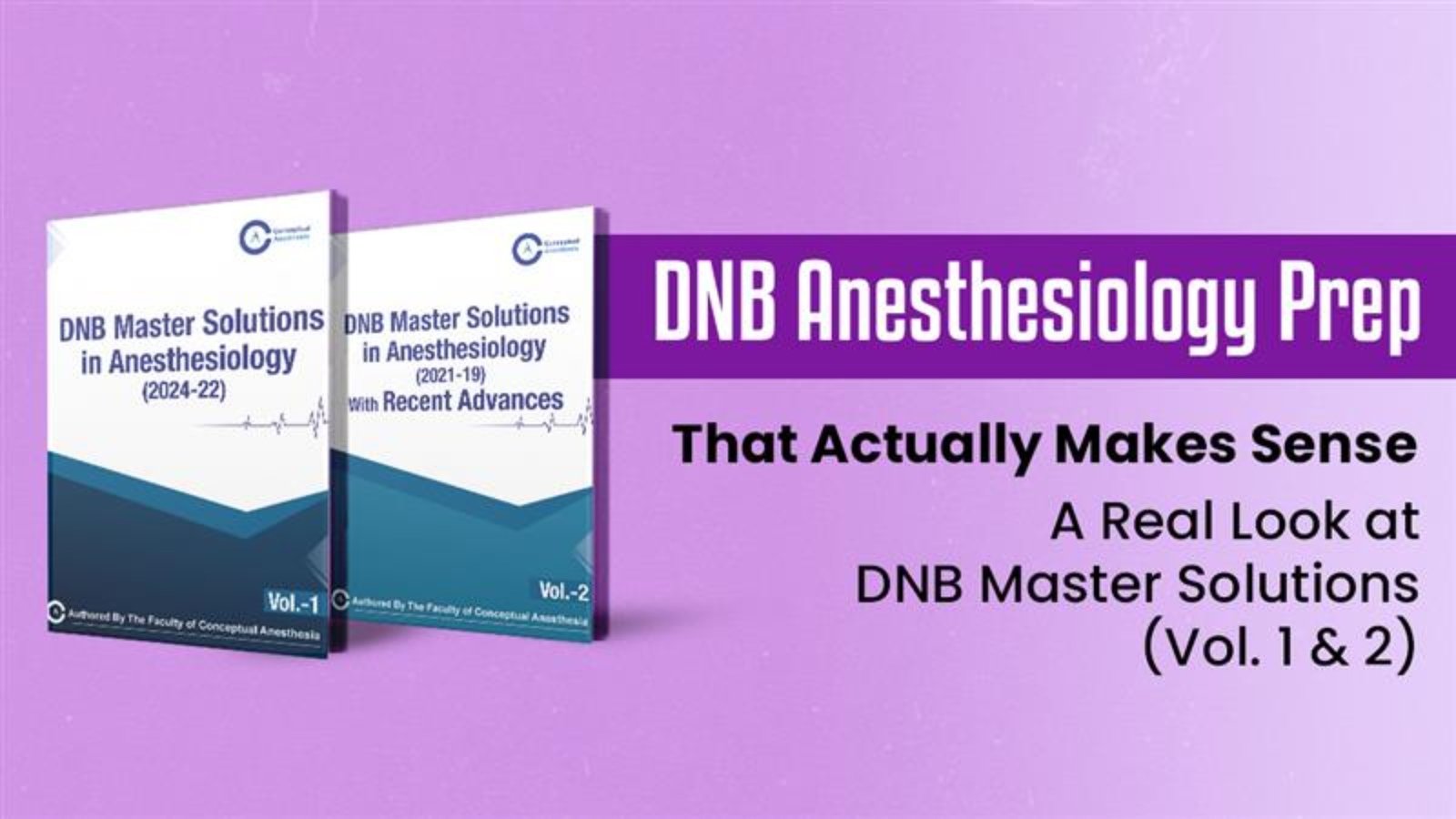
DNB Master Solutions (Vol. 1 & 2)

DNB Anesthesiology Prep That Actually Makes Sense: A Real Look at DNB Master Solutions (Vol. 1 & 2) 

Estimated reading time: 5 minutes

If you’ve spent even a few weeks in Anesthesia residency, you already know this—just reading standard anesthesia books isn’t enough. You go through topics, revise them, maybe even feel confident for a while, but when it comes to writing in the DNB theory exam or structuring answers in the MD Exam or DA Exam, things don’t come out the way you expect. 

That gap is real. And that’s exactly where DNB Master Solutions in Anesthesiology – Volume 1 & Volume 2 by the faculty of Conceptual Anesthesdia start to feel useful—not as another source of study material, but as something that actually helps with exam preparation. 

Volume 1: Recent Papers, Current Pattern (2024–2022) 

Starting with Volume 1—this one feels closest to the actual DNB exam you’re preparing for. 

It covers recent years (2024–22), and you can see the difference. The pattern, the integration, the way questions are asked—it all feels relevant to the current DNB theory format. 

What stands out while using it: 

  • Questions reflect what you’re likely to see in the DNB theory exam  
  • Answers are structured in a way you can reproduce in real exams  
  • It pushes you toward clinical thinking, not just memorization  

If you’re also preparing alongside NEET SS anesthesia or planning ahead for NEET SS exam, this volume aligns well with that level of thinking. 

It’s not complicated reading. You go through an answer once, and it makes sense. That helps more than people realize during heavy neet ss preparation phases. 

Volume 2: Building Depth + Recent Advances (2021–2019) 

Now Volume 2—this one goes a bit older (2021–19), but it plays a different role. 

It helps you slow down a bit and actually understand things properly, especially if you’re early in your anesthesia residency or still figuring out how to approach the DNB theory exam. 

What you’ll notice here: 

  • Slightly more space to build concepts  
  • Better for getting comfortable with answer writing  
  • Includes relevant recent advances without overloading  

For many anesthesia residents, this becomes the starting point. It’s not rushed, and that helps when your base isn’t fully solid yet. 

How to Use These Books? (Without Overcomplicating It) 

Most people try to “complete” books like this. That usually doesn’t work. 

A more practical way: 

  • Try answering first—even if it’s incomplete  
  • Then read the solution and compare  
  • Focus on what you missed (structure matters as much as content)  

Also, don’t ignore timing. Occasionally solving under exam conditions helps with the DNB exam mindset. 

And revision? That’s where this really pays off. The second or third read feels much faster and clearer. 

What Actually Improves Over Time?

If you use both volumes consistently, a few things start changing—not suddenly, but steadily: 

  • Your answers become more structured  
  • You stop writing unnecessary details  
  • You recognize repeated themes across DNB theory and even NEET ss exam patterns  
  • You feel less stuck during long answers  

It’s subtle, but it builds confidence. 

Volume 1 vs Volume 2 — Keep It Simple 

If you’re unsure where to begin, keep it straightforward. 

Start with Volume 1. It reflects the most recent DNB theory exam pattern, so you get used to how questions are currently framed and what the exam expects from your answers. 

Once you’re comfortable with that, move to Volume 2. This helps reinforce your base, gives you more practice with slightly older questions, and strengthens your overall understanding without the pressure of “latest trends.” 

You can examine the sample pages here to quickly obtain a sense of the format, clarity, and question style of both DNB Master Solutions in Anesthesia Volumes 1 and Anesthesia volume 2. 

Final Thought 

Whether it’s the DNB theory exam, MD Exam, DA Exam, or even future NEET SS preparation, the challenge is the same—you need to convert knowledge into answers that score. 

DNB Master Solutions in Anesthesiology – Volume 1 & Volume 2 don’t try to replace your main study material. But they do something equally important—they show you how to apply what you’ve studied. 

And for most anesthesia residents, that’s the part that makes the real difference.

Share

FET Exam

How to Prepare for the FET Exam in One Month: A Conceptual Anesthesia Guide 

Estimated reading time: 5 minutes

You know FET Exam in just one month which can feel very intimidating, or especially when you are especially targeting a super-specialty way through FNB programs. However, if residents have the proper Preparation Strategy, with the strong conceptual clarity, and very well focused exam preparation, it will definitely possible to perform well in exams, although in FET Anesthesia, which has notable overlap with NEET SS Anesthesia and SS Anesthesia. 

This blog will provide a one-month FET Preparation roadmap especially for anesthesia aspirants, which is aligned with the fet syllabus, exam pattern, and real-world clinical application, while keeping FET 2026 in focus. 

Understanding the FET Examination 
What is the FET Exam? 

The FET examination is a national-level entrance examination which is conducted for admission into various FNB programs. The FET entrance examination tests your advanced clinical knowledge helps you in decision-making skills, and application-based understanding rather than factual recall. 

For anesthesia aspirants, the exam closely mirrors the overall conceptual depth, which is required for NEET SS, making it integrated preparation which is highly effective. 

FET Exam Pattern 

A thorough understanding of the exam pattern that is very important before planning your preparation. 

Key features of the FET 2026 exam pattern include: 

  • There will be the single paper with MCQs 
  • Predominantly clinical and scenario-based questions must be important 
  • Emphasis on peri-operative decision making 
  • Time-bound and high-pressure format 

You need to reviewing all the previous FET question papers and, when it will be available, the FET 2026 question paper helps to identify frequently that tested anesthesia concepts and exam trends. 

FET Syllabus for Anesthesia 

The fet syllabus for FET Anesthesia broadly covers: 

  • It covers all the core anesthesia principles 
  • It includes critical care and pain management 
  • Airway management and ventilatory strategies 
  • Peri-operative medicine and emergencies 

The syllabus sometimes overlaps notably with NEET SS Anesthesia, making concept-driven preparation highly efficient. 

One-Month FET Preparation Strategy for Conceptual Anesthesia 

as you know the time is limited, your focus must be shift from the exhaustive reading to important revision and application. 

Week 1: Strengthen Core Anesthesia Concepts 
  • You need to revise the important topics from SS Anesthesia 
  • Focus on the physiology-based anesthesia, pharmacology, and monitoring as well 
  • Always use concise, concept-oriented study material 
  • Please avoid switching between multiple sources 

Goal: Build clarity in concepts that are frequently tested in the FET Exam. 

Week 2: MCQs and Concept Integration 
  • For better clarity, solve previous FET question papers 
  • Practice all type of NEET SS-level anesthesia MCQs 
  • After each question, please thoroughly analyze the reasoning behind the correct and incorrect options 
  • Note weak areas for targeted revision 

This phase bridges theory with clinical application, critical for the FET entrance examination. 

Week 3: Exam Pattern Familiarity and Mock Tests 
  • Try comprehensive practices that are exams based on the format of the test.  
  • Adhere to the fundamentals of rigorous time management.  
  • Thoroughly examine all the errors rather than concentrating just on the ratings. 

By this stage, you should feel comfortable handling the pressure of the FET examination. 

Week 4: Final Revision and High-Yield Focus 
  • Only review previously covered material; and please avoid additional learning resources.  
  • Pay attention to the anesthetic crises and other which often test situations.  
  • Minimal MCQ for practice to keep the learning process continuous 
  • Do not learn every new subject at this time. 

Consistency and calmness are key in the final week. 

Top FET Preparation Tips for Anesthesia Aspirants 
  • Put cognitive clarity ahead of volume.  
  • Prepare for your exam in accordance with NEET SS and FET Anesthesia.  
  • Every day, even if just momentarily, just revise everything 
  • Examine each test and MCQ you take.  
  • Limit yourself to high-quality, limited study materials. 

These fet preparation tips are especially important when time is limited. 

Final Thoughts: Cracking FET 2026 with Conceptual Anesthesia 

It is difficult to prepare for FET 2026 in a single month, but it is unquestionably doable with careful planning and the correct attitude. Candidates who successfully apply the principles in all clinical circumstances and have a thorough understanding of them are rewarded by the FET Exam.  

You can increase your chances of passing this extremely competitive admission test by adhering to a concentrated preparation strategy, which includes understanding the FET 2026 exam format and aligning your study with NEET SS Anesthesia and SS Anesthesia. 

Stay focused, stay conceptual, and trust your preparation. 

Share

Dr. Kishore Mangal

ICU Patient Can’t Move – Can You Diagnose the Cause? Critical Care MCQs Explained by Dr. Kishore Mangal

Estimated reading time: 4 minutes

In the ICU, a patient who suddenly cannot move is a clinical emergency. While stroke and intracranial hemorrhage are often the first thoughts, many other neurological causes must be considered—especially in critically ill patients.

This blog walks you step by step through how to localise weakness, differentiate causes, and apply this knowledge to high-yield ICU MCQs.

Step 1: Localising the Cause of Weakness in the ICU

Generalised weakness in ICU patients can be classified based on the level of neurological involvement.

1. Brainstem Pathology – Locked-In Syndrome

When the brainstem is involved, patients may present with:

  • Sudden onset quadriplegia
  • Preserved vertical eye movements
  • Ability to open eyelids
  • Complete inability to move limbs

This classic presentation is called Locked-In Syndrome.
👉 Diagnosis: Neuroimaging (MRI brainstem)

2. Motor Neuron Diseases (UMN + LMN Involvement)

Diseases like ALS or other motor neuron disorders show:

  • Increased reflexes
  • Upper motor neuron signs
  • High muscle tone
  • Fasciculations
  • Positive Babinski sign
  • Asymmetrical weakness

These features help differentiate motor neuron disease from peripheral causes.

3. Spinal Cord Causes – Acute Transverse Myelitis

Spinal cord pathology often presents as paraplegia or quadriplegia.

Key features of Acute Transverse Myelitis:
  • Motor and sensory loss below a defined spinal level
  • Clearly demarcated sensory level
  • Possible bladder and bowel involvement
  • Rapid progression

👉 Diagnosis: Contrast MRI spine

Other spinal causes include:

  • Tumors
  • Epidural abscess
  • Spinal cord infarction
4. Peripheral Nerve Disorders
Guillain-Barré Syndrome (GBS)

The most common peripheral nerve cause in ICU.

Typical features:

  • Ascending symmetrical weakness
  • Areflexia
  • Recent infection or vaccination
  • No UMN signs

👉 Diagnosis:

  • Lumbar puncture
  • Nerve conduction studies
ICU-Acquired Weakness / Critical Illness Neuromyopathy

Seen in patients with:

  • Prolonged ICU stay
  • Multi-organ dysfunction
  • Sepsis

Clinical clues:

  • Symmetrical weakness
  • Normal cranial nerves
  • Absent reflexes
  • Difficulty weaning from ventilator
  • Possible diaphragmatic involvement

👉 Investigations:

  • Nerve conduction studies
  • CPK (may be mildly elevated in myopathy)
Other Peripheral Causes
  • Vitamin B12 deficiency
    • Glove and stocking sensory loss
    • Megaloblastic anemia (↑ MCV, MCH)
  • Heavy metal poisoning
5. Neuromuscular Junction Disorders
Myasthenia Gravis

Key features:

  • Ptosis and diplopia
  • Cranial muscles involved early
  • Fatigability (worsens with activity)
  • Weakness worse in the evening

👉 Diagnosis:

  • ACh receptor antibodies
  • EMG
  • Edrophonium test
Lambert-Eaton Syndrome

How it differs from Myasthenia:

  • Often associated with malignancy
  • Weakness improves with exercise (important exam point)
Botulism & Organophosphate Poisoning
  • Cranial nerve weakness
  • History of toxin ingestion
6. Muscle Disorders (Myopathies)

Common ICU-related causes:

  • Critical illness myopathy
  • Steroid-induced myopathy
  • Electrolyte imbalance
  • Malnutrition
  • Hypercatabolic states

Clinical pattern:

  • Predominantly proximal muscle weakness
  • Reflexes are usually preserved initially
Neuropathy vs Myopathy – Quick Differentiation
FeatureNeuropathyMyopathy
WeaknessDistalProximal
Sensory symptomsPresentAbsent
ReflexesLost earlyPreserved
FasciculationsMay be presentAbsent
UMN vs LMN Lesions – Exam Rule
  • Lesión above anterior horn cell → UMN
  • Lesion at or below the anterior horn cell → LMN

UMN:
More tone, more reflexes, positive Babinski
LMN:
Less tone, less reflexes, muscle atrophy, fasciculations

High-Yield ICU MCQs Explained
MCQ 1: Transverse Myelitis vs GBS

Most specific feature of transverse myelitis:
✅ Well-defined sensory level on trunk

MCQ 2: Shock in High Thoracic Myelitis

Patient with T4 lesion, hypotension, bradycardia, warm extremities:
✅ Neurogenic shock

MCQ 3: No Improvement After Steroids in Myelitis

Next best step after IV methylprednisolone failure:
✅ Plasmapheresis

Guillain-Barré Syndrome – ICU Essentials
When to Intubate in GBS?

Use the 20–30–40 rule:

  • FVC < 20 ml/kg
  • MIP < 30 cm H₂O
  • MEP < 40 cm H₂O

Additional red flags:

  • Bulbar weakness
  • Pooling of secretions
  • Facial diplegia
  • Rising CO₂ despite tachypnea
GBS Overview
  • Autoimmune demyelinating neuropathy
  • Often post-infection
  • Ascending paralysis
  • Peak at 2–4 weeks
CSF:
  • High protein
  • Normal cell count
    (Cyto-albuminologic dissociation)
Types of GBS (Exam Favorite)
  • AIDP / AMSAN – Motor + sensory
  • AMAN – Pure motor
  • Miller-Fisher Syndrome – Ophthalmoplegia, ataxia, areflexia
  • PCB variant – Pharyngeal, cervical, brachial weakness
  • Autonomic GBS – Severe dysautonomia
GBS Treatment
  • IVIG or Plasma Exchange (equally effective)
  • ❌ No role of steroids
  • Supportive ICU care is crucial
Prognostic Scores in GBS
  • EGOS – Predicts walking ability at 6 months
  • EGRIS – Predicts risk of respiratory failure
Final Takeaway

In ICU patients with weakness, localisation is everything.
From brainstem to muscle, a structured approach helps you diagnose faster, manage better, and answer MCQs confidently.

This session is not just exam-oriented—it mirrors real ICU decision-making, where early diagnosis can change outcomes.

Subscribe to Conceptual Anesthesia for more insightful sessions.

Share

NEET SS Exam

NEET SS Exam: Why NEET SS Aspirants Prefer Conceptual Anesthesia for Their Final Prep

Estimated reading time: 3 minutes

As NEET SS gets closer, most anesthesia residents are rushing to revise the important topics, sort out their weak areas, and find a clear way to finish the syllabus on time. At this stage, what you need is not more material but a platform that gives direction.
This is why many students lean toward Conceptual Anesthesia in the last stretch. It keeps things organised and helps you understand what really matters for the exam.

What Makes Conceptual Anesthesia a Strong Choice?

One thing most students appreciate is that the platform explains things in a simple, practical manner. Nothing feels rushed or overly complicated, which makes revision easier.

  1. Clinical Demonstrations That Build Real Understanding
  • Instead of only reading theory, you get to see how concepts look in clinical settings. These demonstrations help you connect what you study with what you will actually face in the exam or in the OT.
  1. Theory Notes That Are Easy to Revise
  • The notes are clear and exam-focused. You don’t have to spend hours collecting PDFs or searching for explanations. Everything you need is kept in one place, which saves a lot of time.
  1. DNB OSCE Sessions That Remove the Fear Factor
  • OSCE is one area where many students struggle because they rarely get structured practice.
  • Conceptual Anesthesia walks you through stations, equipment, drugs, and common exam patterns so that you feel more prepared and less anxious.
  1. Hardcopy Books That Help You Stay Consistent
  • Students like having physical books because they are easier to revise repeatedly.
  • The Conceptual Anesthesia book set covers high-yield theory, updated guidelines, and quick revision points that are helpful in the final weeks.
  1. Live Sessions With Senior Faculty
  • The live discussions are one of the strongest parts of the platform. Teachers pick important and tricky topics, discuss real cases, and guide you on areas students usually make mistakes in.
Everything You Need for NEET SS in One Place

You get:

  • Solved question papers
  • SS-oriented MCQ discussions
  • A proper question bank to practise
  • Quick revision pearls
  • Guidance on high-yield topics
  • Books + clinical demos + theory notes + OSCE content

This removes the confusion of switching between multiple sources and gives you a straightforward plan to follow.

Why It Works Well for Last-Month Preparation?

At this stage, what you really need is clarity. Conceptual Anesthesia gives you a neat structure, reliable content, and regular guidance so you don’t feel lost. It helps you revise faster, remember better, and stay confident for the exam.

If you want, I can also write a shorter marketing version, a mailer, or a social media caption based on this.

Share