Dr. Jhanvi Bajaj

DNB Oct 2025 (Paper 2, Part 3): Spinal Additives, PDPH, & Neurological Complications Explained by Dr. Jhanvi Bajaj

Estimated reading time: 4 minutes

DNB theory examiners love testing whether you actually understand clinical concepts or if you’ve just blindly memorized a textbook. A perfect example is this high-yield question from the October 2025 exam, which links three massive topics: Spinal Additives, Neurological Complications, and PDPH. 

At first glance, it looks like an absolute mountain of text to write. But if you structure your thoughts systematically, it is actually an easy question to score top marks on. 

1. Mastering Spinal Additives 

Spinal additives are mixed with local anesthetics (like bupivacaine) to improve block quality, speed up onset, and prolong analgesia. To score well, don’t just dump a random list of drugs on the page—classify them clearly. 

Opioids 

  • Fentanyl: Highly popular for excellent, rapid analgesia with minimal hemodynamic shifts. 
  • Morphine: The gold standard for long-lasting postoperative pain relief, but you must monitor for delayed respiratory depression. 
  • Sufentanil: Provides intense analgesia with a shorter duration and fewer respiratory risks than morphine. 

Alpha-2 Agonists 

  • Clonidine & Dexmedetomidine: Act on the dorsal horn of the spinal cord to blunt pain signaling. Anesthesiologists love clonidine for significantly extending both sensory and motor blocks, though you must watch out for bradycardia, hypotension, and mild sedation. 

Vasoconstrictors 

  • Adrenaline: Constricts local blood vessels to reduce the systemic uptake of the local anesthetic. This keeps the drug at the source longer, extending the block’s lifespan. 

Other Additives 

  • Ketamine, Magnesium Sulfate, Midazolam, and Neostigmine. 
  • The Golden Rule: Every intrathecal additive must be preservative-free. Preservatives are highly neurotoxic and can cause severe, permanent neural damage. 

2. Neurological Complications of Spinal Anesthesia 

While spinal anesthesia is incredibly safe, complications happen. Focus heavily on these three major ones for your answer: 

Post-Dural Puncture Headache (PDPH) 

  • The Cause: Continuous leakage of CSF through the dural puncture site drops intracranial pressure. 
  • The Presentation: A severe frontal or occipital headache that is intensely postural (worsens on sitting/standing, improves when lying flat). It typically sets in within 24–48 hours. 
  • The Mechanism: Loss of CSF cushioning creates traction on pain-sensitive intracranial structures and cranial nerves, causing compensatory cerebral vasodilation. 
  • Treatment: Bed rest, aggressive hydration, simple analgesics, and caffeine. The gold standard for persistent cases is an epidural blood patch. 

Epidural Hematoma 

  • The Cause: Accidental vascular puncture during needle insertion, with the risk skyrocketing in anticoagulated patients. 
  • The Presentation: Sudden, severe back pain paired with rapidly progressing lower limb weakness or paraplegia. 
  • The Action: This is a surgical emergency requiring immediate decompression to avoid permanent paralysis. 

Meningitis 

  • The Cause: Bacterial contamination of the subarachnoid space due to a breach in sterile technique. 
  • The Presentation: High fever, neck stiffness, severe headache, and positive Kernig’s/Brudzinski’s signs. Confirmed via CSF analysis and treated with immediate, targeted antibiotics. 

💡 Quick-Yield Complications to Mention: 

  • TNS (Transient Neurological Symptoms): Buttock and thigh pain historically tied to hyperbaric lidocaine; resolves spontaneously. 
  • Cauda Equina Syndrome: Rare, devastating nerve root damage causing bowel/bladder dysfunction and saddle anesthesia. 
  • Anterior Spinal Artery Syndrome: Ischemia to the anterior two-thirds of the cord, causing motor loss but sparing proprioception. 
  • Arachnoiditis: Severe chronic inflammation often triggered by preservatives or contaminants. 

3. Factors Influencing PDPH 

The risk of a patient developing PDPH boils down to a mix of patient anatomy and provider technique: 

Patient-Specific Factors Procedure-Related Factors 
• Young age (elastic dural fibers) • Multiple puncture attempts 
• Female gender • Larger needle gauges 
• Pregnancy / Labor • Cutting-tip needles (e.g., Quincke) 
• Prior history of PDPH or chronic headaches • Perpendicular bevel orientation 

The Classic Exam Scenario: A young, pregnant female undergoing a C-section where an inexperienced operator makes multiple attempts using a large, cutting needle. She ticks every single risk factor box. 

Wrapping Up 

Instead of trying to memorize these lists blindly, focus on the underlying clinical anatomy. Once you understand the why, recalling it under exam pressure becomes second nature. 

Want to take the stress out of your exam prep? We’ve got you covered. 

  • Watch the full video breakdown: Head over to Conceptual Anesthesia on YouTube to watch this complete session. 
  • Get the complete series: Download the eConceptual and subscribe to Anesthesia  to unlock all our high-yield exam sessions, structured notes, and practical fundamental guides designed to help you ace your DNBs! 

Watch Video: DNB Oct 2025 Paper 2 Part 3 | Spinal Additives, PDPH & Neurological Complications | Dr. Jhanvi Bajaj 

Share

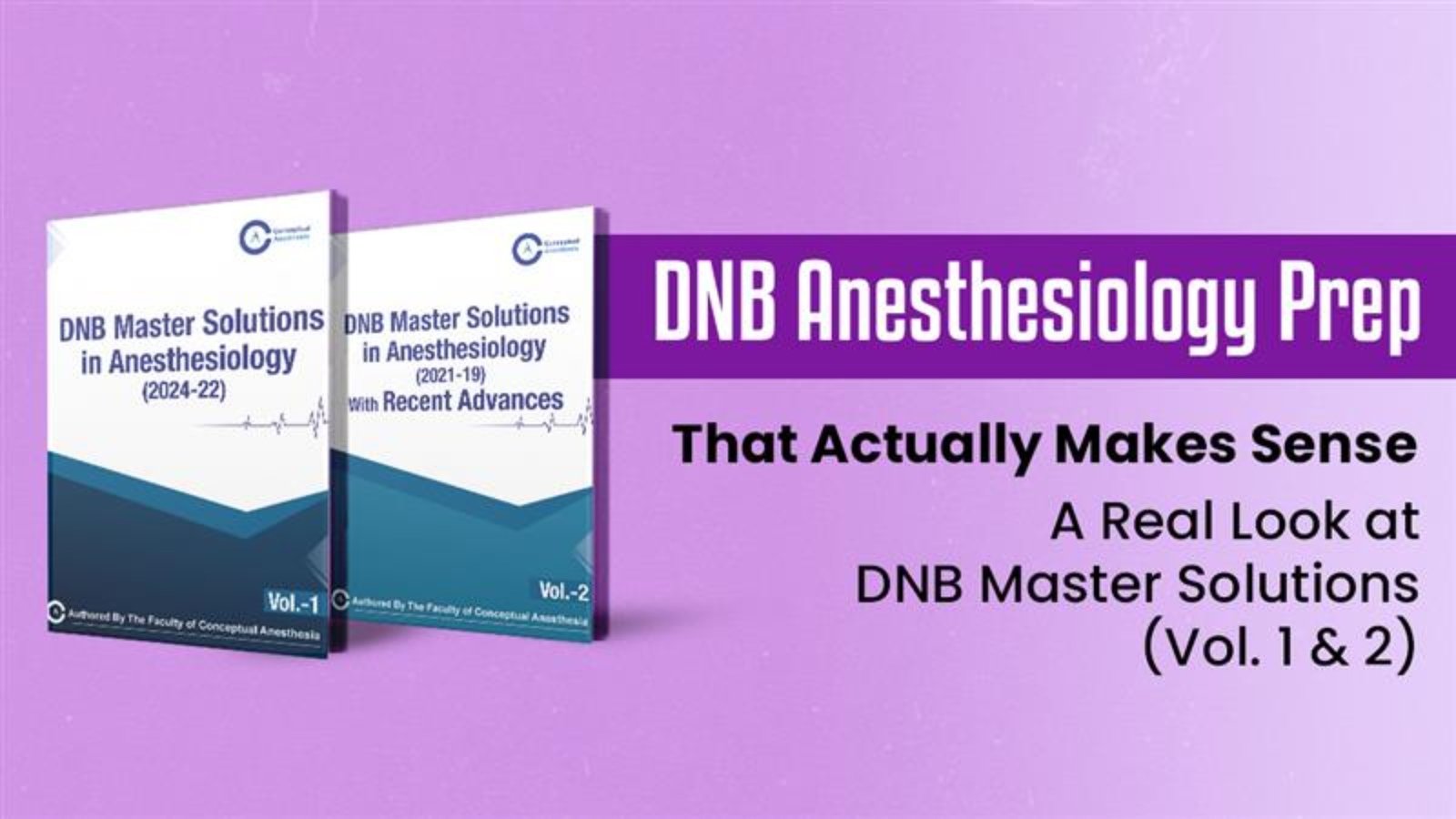
DNB Master Solutions (Vol. 1 & 2)

DNB Anesthesiology Prep That Actually Makes Sense: A Real Look at DNB Master Solutions (Vol. 1 & 2) 

Estimated reading time: 5 minutes

If you’ve spent even a few weeks in Anesthesia residency, you already know this—just reading standard anesthesia books isn’t enough. You go through topics, revise them, maybe even feel confident for a while, but when it comes to writing in the DNB theory exam or structuring answers in the MD Exam or DA Exam, things don’t come out the way you expect. 

That gap is real. And that’s exactly where DNB Master Solutions in Anesthesiology – Volume 1 & Volume 2 by the faculty of Conceptual Anesthesdia start to feel useful—not as another source of study material, but as something that actually helps with exam preparation. 

Volume 1: Recent Papers, Current Pattern (2024–2022) 

Starting with Volume 1—this one feels closest to the actual DNB exam you’re preparing for. 

It covers recent years (2024–22), and you can see the difference. The pattern, the integration, the way questions are asked—it all feels relevant to the current DNB theory format. 

What stands out while using it: 

  • Questions reflect what you’re likely to see in the DNB theory exam  
  • Answers are structured in a way you can reproduce in real exams  
  • It pushes you toward clinical thinking, not just memorization  

If you’re also preparing alongside NEET SS anesthesia or planning ahead for NEET SS exam, this volume aligns well with that level of thinking. 

It’s not complicated reading. You go through an answer once, and it makes sense. That helps more than people realize during heavy neet ss preparation phases. 

Volume 2: Building Depth + Recent Advances (2021–2019) 

Now Volume 2—this one goes a bit older (2021–19), but it plays a different role. 

It helps you slow down a bit and actually understand things properly, especially if you’re early in your anesthesia residency or still figuring out how to approach the DNB theory exam. 

What you’ll notice here: 

  • Slightly more space to build concepts  
  • Better for getting comfortable with answer writing  
  • Includes relevant recent advances without overloading  

For many anesthesia residents, this becomes the starting point. It’s not rushed, and that helps when your base isn’t fully solid yet. 

How to Use These Books? (Without Overcomplicating It) 

Most people try to “complete” books like this. That usually doesn’t work. 

A more practical way: 

  • Try answering first—even if it’s incomplete  
  • Then read the solution and compare  
  • Focus on what you missed (structure matters as much as content)  

Also, don’t ignore timing. Occasionally solving under exam conditions helps with the DNB exam mindset. 

And revision? That’s where this really pays off. The second or third read feels much faster and clearer. 

What Actually Improves Over Time?

If you use both volumes consistently, a few things start changing—not suddenly, but steadily: 

  • Your answers become more structured  
  • You stop writing unnecessary details  
  • You recognize repeated themes across DNB theory and even NEET ss exam patterns  
  • You feel less stuck during long answers  

It’s subtle, but it builds confidence. 

Volume 1 vs Volume 2 — Keep It Simple 

If you’re unsure where to begin, keep it straightforward. 

Start with Volume 1. It reflects the most recent DNB theory exam pattern, so you get used to how questions are currently framed and what the exam expects from your answers. 

Once you’re comfortable with that, move to Volume 2. This helps reinforce your base, gives you more practice with slightly older questions, and strengthens your overall understanding without the pressure of “latest trends.” 

You can examine the sample pages here to quickly obtain a sense of the format, clarity, and question style of both DNB Master Solutions in Anesthesia Volumes 1 and Anesthesia volume 2. 

Final Thought 

Whether it’s the DNB theory exam, MD Exam, DA Exam, or even future NEET SS preparation, the challenge is the same—you need to convert knowledge into answers that score. 

DNB Master Solutions in Anesthesiology – Volume 1 & Volume 2 don’t try to replace your main study material. But they do something equally important—they show you how to apply what you’ve studied. 

And for most anesthesia residents, that’s the part that makes the real difference.

Share

Dr. Jhanvi Bajaj

LMA Types Explained for PDCET & DNB Exams: First vs Second Generation LMA by Dr. Jhanvi Bajaj 

Estimated reading time: 6 minutes

Airway management is an important topic in anesthesia, and Laryngeal Mask Airways (LMAs) are frequently asked about in exams like PDCET and DNB. In this session, Dr. Jhanvi Bajaj explains the different types of LMAs, how to identify them, and the key exam points you should remember. 

Let’s go through them step by step. 

First Generation LMAs 

Let’s start with the first generation LMAs. 

They are called first generation because they have only a single tube coming out of them. This single tube is the airway tube. 

Since these LMAs do not have a separate gastric drainage tube, they are prone to the risk of aspiration. They also do not create a strong seal with the larynx, which is why they are not preferred in many situations today. 

However, you must still be able to identify them in exams. 

LMA Classic 

The first LMA you may see is the LMA Classic. 

Features include: 

  • A silicon cuff 
  • A pilot balloon used to inflate the cuff 
  • A single airway tube 

This is the classic reusable LMA. 

LMA Unique 

Now imagine an LMA that looks similar to the LMA Classic, but it is disposable. 

This one is made of PVC material, which means it is designed for single use. 

You use it once and discard it, and this LMA is called LMA Unique. 

Important Exam Point 

A common exam question is: 

How many times can silicon-based LMAs be reused? 

The answer is up to 40 times. 

The method of sterilization used for LMAs is autoclaving. 
So the sequence is: 

  1. Wash the LMA 
  1. Sterilize it using autoclaving 
LMA Flexible 

Another important LMA for exams is the LMA Flexible. 

It is commonly used in: 

  • Head and neck surgeries 
  • Intraoral surgeries 
  • Neurosurgeries 
  • Situations where the patient may be in the prone position 

This LMA is still first generation, because it has only one tube. 

How do you identify it? 

Inside the tube, you will notice small metallic wirings. These wires allow the LMA to bend at different angles without kinking the lumen. 

Because of this flexibility, it is very useful when the airway needs to be shared with the surgeon. 

Second Generation LMAs 

Now let’s move to second -generation LMAs. 

The major difference is simple: 

Second generation LMAs have two tubes. 

These include: 

  • A large airway tube used for ventilation 
  • A smaller gastric drainage tube 

The gastric drainage tube allows insertion of a Ryle’s tube, which helps remove gastric or esophageal contents. This significantly reduces the risk of aspiration. 

Other parts you may notice include: 

  • Fixation tab – helps secure the LMA at the teeth 
  • Bite block – prevents damage to the LMA if the patient bites during recovery from anesthesia 

If the LMA is made of transparent PVC material, it usually means it is single-use. 

LMA Supreme 

One of the most commonly used LMAs is the LMA Supreme. 

Features include: 

  • Two tubes (airway + gastric) 
  • Transparent PVC material 
  • Disposable design 

Because of these features, it is widely used in clinical practice. 

LMA ProSeal 

Another very important LMA is the LMA ProSeal. 

This LMA: 

  • Has two tubes 
  • Is made of silicon material 
  • Is reusable 

Since it is silicon-based, it can be autoclaved and reused up to 40 times. 

LMA ProSeal is one of the most commonly used LMAs worldwide. 

It is especially preferred for: 

  • Daycare anesthesia 
  • Laparoscopic surgeries 
Ambu LMAs 

Next are LMAs manufactured by the Ambu company. 

These are usually colored LMAs, which helps in identifying them. 

Ambu Aura 40 

The Ambu Aura 40 is a first generation LMA. 

How do you identify it? 

Just check the number of tubes: 

  • One tube → First generation 

The name Aura 40 comes from the fact that it can be reused up to 40 times after sterilization. 

Ambu Aura Gain 

Another LMA from the same company is Ambu Aura Gain. 

This LMA has: 

  • One airway tube 
  • One gastric tube 

So it clearly belongs to the second generation LMAs. 

A simple way to remember it is: 

Ambu Aura Gain = Ambu Aura Green 

Since the LMA is green in color, it becomes easy to recall the name. 

I-gel LMA 

Another very important LMA for exams is the I-gel LMA. 

You can identify it easily because there is no pilot inflation balloon. 

So the obvious question is: 

How does the cuff inflate? 

The answer is that I-gel is made of thermo-elastic material. 

When inserted into the airway, this material responds to body temperature, expands slightly, and creates a seal around the laryngeal structures. 

Because of this property: 

  • No cuff inflation is required 
  • There is no pilot balloon 

So if the exam asks: 

Which LMA is a second generation cuffless LMA? 

The answer is I-gel LMA. 

Quick Revision 

Here’s a quick recap: 

First Generation LMAs 

  • LMA Classic 
  • LMA Unique 
  • LMA Flexible 
  • Ambu Aura 40 

Second Generation LMAs 

  • LMA Supreme 
  • LMA ProSeal 
  • Ambu Aura Gain 
  • I-gel LMA 

The easiest way to identify them in exams is to count the number of tubes: 

  • One tube → First generation 
  • Two tubes → Second generation 

Understanding the different types of LMAs and how to identify them is extremely important for exams like PDCET and DNB. Many questions are image-based, so simply remembering the number of tubes, material used, and special identifying features can help you quickly pick the right answer. If you focus on these small but important details, revising LMAs becomes much easier and far less confusing during exam preparation. 

If you want clearer, exam-oriented explanations of anesthesia topics, make sure to subscribe to Conceptual Anesthesia. Stay connected for more high-yield sessions. quick revisions, and practical exam tips that will help you prepare smarter for your upcoming exams. 

Share

Anesthesia Residents

Master’s Degrees in Anaesthesia After MBBS in India: MD, DNB, and DA

Estimated reading time: 4 minutes

Anaesthesia is often misunderstood. Many people think it’s only about putting patients to sleep before surgery. Anyone who has spent even a few days in an operating theatre or ICU knows that this couldn’t be further from the truth.

The Anesthesia branch is about vigilance, judgment, and responsibility. When things go wrong during surgery or in the ICU, the anaesthesiologist is usually the first one expected to act—and act fast.

If you’re an MBBS graduate considering Anaesthesia for postgraduation, it’s important to understand what degrees are available in India and what kind of future they actually offer. Let’s talk about this honestly, without exaggeration.

MD (Doctor of Medicine) in Anesthesiology

MD – Doctor of Medicine in Anesthesiology is the most commonly pursued postgraduate degree in Anaesthesia in India. It is a three-year course conducted in medical colleges recognised by the National Medical Commission (NMC).

MD Anaesthesiology training is intense. You don’t just learn drugs and doses—youknown how to manage airways, unstable vitals, emergency situations, and critically ill patients. A large part of your residency is spent inside operating theatres and Intensive Care Units.

Over time, you start understanding that Anaesthesia is less about routine work and more about preparedness. Every case is different, and that’s what keeps the branch challenging.

Scope After MD (Doctor of Medicine) Anaesthesiology

After completing MD Anesthesia, most doctors work as consultant anaesthesiologists in hospitals. Many also choose to:

  • Work predominantly in ICUs
  • Take up senior residency and later teaching roles.
  • Pursue further training in critical care or pain medicine.

MD Anaesthesia offers strong job stability. Surgical services are expanding across India, and anesthesiologists are needed everywhere—from small nursing homes to large corporate hospitals.

DNB (Diplomate of National Board) in Anaesthesia

DNB – Diplomate of National Board in Anaesthesia is awarded by the National Board of Examinations (NBE). Like MD, it is a three-year postgraduate program and is well recognised across the country.

DNB training usually happens in large hospitals rather than traditional medical colleges. This often means heavier workloads and greater clinical responsibility early on. Many DNB residents gain excellent hands-on experience because of this exposure.

In real-world practice, the difference between MD and DNB matters far less than how confident and competent you are clinically.

Scope After DNB (Diplomate of National Board) Anaesthesia

After DNB Anaesthesia, doctors can:

  • Work as consultants in private and corporate hospitals
  • Join trauma centres and ICUs
  • Enter academics after fulfilling eligibility norms.
  • Go on to do fellowships or super-specialisation

Today, DNB Anaesthesia is widely accepted, and most hospitals value skill and experience over the name of the degree.

DA (Diploma in Anesthesia): What You Should Know

DA – Diploma in Anesthesia was a two-year postgraduate diploma that existed earlier. Over the years, this course has been largely phased out, with MD and DNB becoming the standard options.

Doctors who already have a DA degree continue to practice successfully, especially with experience. However, for new aspirants, MD or DNB Anaesthesia is the recommended route.

What Can You Do After Postgraduate Anaesthesia?

Many anaesthesiologists choose to specialise further once they complete their postgraduate degree. Some common paths include:

  • Critical Care Medicine
  • Pain Medicine
  • Cardiac Anaesthesia
  • Neuro-Anaesthesia
  • Paediatric Anaesthesia

These areas allow doctors to focus on specific interests and often come with higher responsibility and expertise-based roles.

Final Words: 

Choosing between MD (Doctor of Medicine) Anaesthesiology and DNB (Diplomate of National Board) Anaesthesia is important, but choosing Anaesthesia itself is the bigger decision. Both degrees offer strong careers, steady demand, and long-term security in India.

If you’re willing to take on responsibility when it matters most, Anaesthesia can be one of the most rewarding medical careers you’ll ever choose.

Share

Conceptual Anesthesia

Diwali Dhamaka Offer – Saal Ka Sabse Bada Discount on Conceptual Anesthesia!

Estimated reading time: 2 minutes

Diwali is not just about lights and sweets — it’s also about grabbing the right opportunities.
And if you’re an MD/DNB Anesthesia resident or starting your NEET SS prep, this one is for you.

This festive season, Conceptual Anesthesia brings the biggest Diwali discount — the kind you shouldn’t think twice about. It’s your chance to learn from the best, stay exam-ready, and get everything you need for your residency in one complete place.

Diwali Dhamaka Offer:

Flat ₹12,000 OFF + 3 Months Extra FREE

Offer valid from 3rd October, 12:00 AM to 23rd October, 11:59 PM

💫 Use Code: ECBLOG and grab your discount before it ends!

What Makes Conceptual Anesthesia Different?
  • Residency isn’t easy — every day brings a new case, a new challenge, and very little time to sit and study.
  • That’s exactly why this platform was made — to help you learn smartly, in a way that actually fits your schedule.
  • No overloading, no confusion — just simple, solid concepts you can use right in your OT and exams.
What You Get with Premium Access?
  • Clinical Examination & Demonstration – Learn every step the way it happens in real life.
  • Theory Notes & Discussions – Easy-to-grasp explanations that clear your basics once and for all.
  • DNB OSCE Sessions – The most exam-relevant practice, covering common and tricky cases.
  • Conceptual Anesthesia Books (Hardcopy) – The trusted guides every resident should have.
  • Live Sessions by Legendary Faculties – Learn directly from experts who’ve seen it all.
  • Solved Papers & Question Bank – Perfect for quick revision and confidence building.
  • Live MCQ Discussions & Pearls – Focus on the must-know points that can make all the difference.
Why You Shouldn’t Miss This?

This isn’t just another course, it’s an experience that changes the way you see anesthesia.
Whether you’re in your first year or preparing for superspeciality exams, this offer is truly worth it.

This Diwali, instead of waiting for the “right time,” make it the start of your best learning phase.

Grab the Biggest Diwali Offer Now!Join Conceptual Anesthesia today and unlock full access to everything — clinical videos, books, live classes, and more.
Don’t miss it — because deals like this don’t come twice in a year.

Share

DNB/MD Exam Preparation

DNB or MD: Which Offers Better Career Opportunities in Anesthesia?

Estimated reading time: 4 minutes

The decision between DNB (Diplomate of National Board) and MD (Doctor of Medicine) for a career in Anesthesia usually pops into the mind of many medical aspirants. Both provide highly excellent career prospects, however, with different advantages and challenges. In this blog, we will try to compare both of them and help you make an informed choice.

Understanding DNB and MD in Anesthesia
MD in Anesthesia

MD in Anesthesia is a postgraduate degree offered by medical colleges associated with universities and is regulated by the Medical Council of India (MCI) (now under the National Medical Commission – NMC). Admission to MD programs is through the NEET PG examination.

DNB in Anesthesia

The DNB examination is conducted by the National Board of Examinations (NBE). DNB courses are available in accredited hospitals all over India, and admission is also based on the NEET PG examination.

Differences Between DNB and MD in Anesthesia
1. Training and Exposure

MD Residency: Training is conducted in medical colleges with a structured academic curriculum, regular case discussions, and a strong focus on theoretical knowledge.

DNB Residency: The practice is done in private hospitals and some government institutions. The hands-on clinical exposures may be highly rewarding, but formal academics may not always receive a top priority.

2. Examination Structure

MD Exam Preparation: The MD exam is conducted by the university and includes internal assessments, theory papers, and practicals.

DNB Exam Preparation: The DNB examination is considered more challenging as it has a national-level standardized exam, with stringent practicals and evaluations.

Also Read: The Future of Anesthesia: Trends and Predictions

3. Recognition and Job Opportunities
  • MD in Anesthesia is widely recognized in both government and private hospitals, making it easier to secure academic positions.
  • DNB in Anesthesia is equally valued, but some hospitals and state governments may prefer MD candidates for academic roles.
  • The MS residency is not relevant to Anesthesia because it is a non-surgical speciality.
4. Private Practice and Academics
  • MDs are likely to get more opportunities for teaching jobs in medical colleges.
  • DNBs require extra effort to settle down in academia, but they can shine well in private and corporate hospitals.
How Conceptual Anesthesia Can Help in Anesthesia Residency?

Conceptual Anesthesia offers structured resources and expert-led sessions for aspiring anesthesiologists. With our Premium Membership, you get unlimited access to the following:

  • Clinical Examination and Demonstration
  • Theory Notes & Discussions
  • DNB OSCE Sessions
  • Conceptual Anesthesia Books (Hardcopy)
  • Live Sessions by Legendary Faculties on Important & Rare Cases
  • Solved Question Papers
  • Live MCQ Discussions for SS Exams
  • Question Bank to practice MCQs for SS Exams
  • Pearls to Revise Important & High Yield Points
  • … and many more worthy resources to facilitate your preparation and clinical skills.
Which One Do You Choose?

Your choice must be guided by your career expectations:

  • If you want a well-structured academic environment and find it easier to get into teaching positions, the MD is more suitable. 
  • If you want immense clinical exposure and are okay with self-learning, DNB will be the most suitable for you.
  • No matter what the way is, preparation for DNB exams, MD exams, and NEET PG is a must to get admission in a reputed institution.
Conclusion

Both DNB and MD in Anesthesia provide excellent career opportunities. Although MD has a traditional edge in academics, DNB provides solid clinical training. As regulations are changing, DNB is now widely accepted and recognized. Your focus should be on choosing a good institute, working hard, and ensuring quality MD residency or DNB residency training for a successful career in Anesthesia.

Also Read: The Road to Success for the Anesthesia Resident: Tips and Resources to Thrive in Anesthesia Residency

If you’re preparing for NEET PG, DNB examination, or MS exam preparation, stay dedicated and choose the path that aligns with your career goals!

Share