If you’ve spent even a few weeks in Anesthesia residency, you already know this—just reading standard anesthesia books isn’t enough. You go through topics, revise them, maybe even feel confident for a while, but when it comes to writing in the DNB theory exam or structuring answers in the MD Exam or DA Exam, things don’t come out the way you expect.
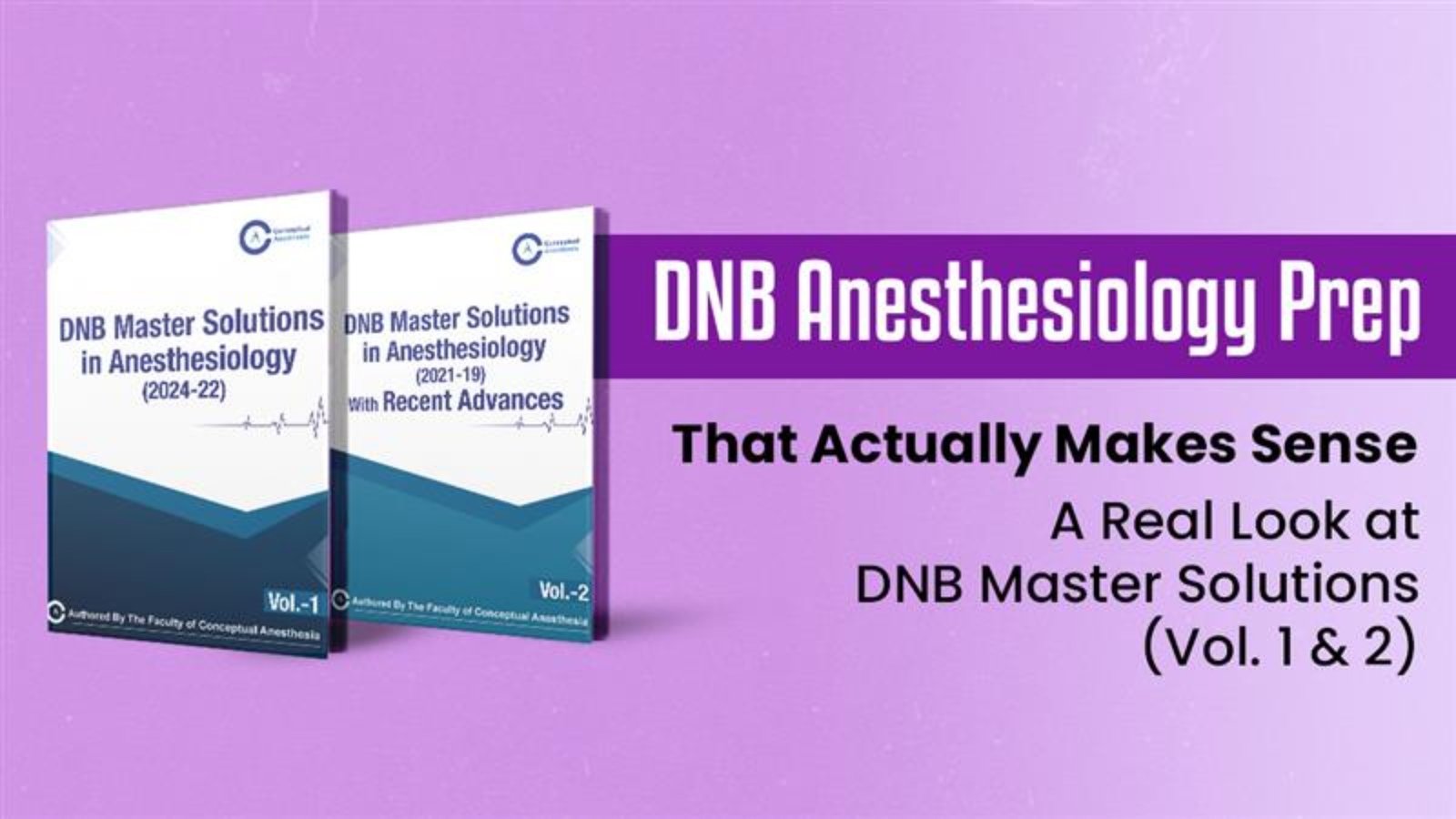
That gap is real. And that’s exactly where DNB Master Solutions in Anesthesiology – Volume 1 & Volume 2 by the faculty of Conceptual Anesthesdia start to feel useful—not as another source of study material, but as something that actually helps with exam preparation.
Volume 1: Recent Papers, Current Pattern (2024–2022)
Starting with Volume 1—this one feels closest to the actual DNB exam you’re preparing for.
It covers recent years (2024–22), and you can see the difference. The pattern, the integration, the way questions are asked—it all feels relevant to the current DNB theory format.
What stands out while using it:
Questions reflect what you’re likely to see in the DNB theory exam
Answers are structured in a way you can reproduce in real exams
It pushes you toward clinical thinking, not just memorization
If you’re also preparing alongside NEET SS anesthesia or planning ahead for NEET SS exam, this volume aligns well with that level of thinking.
It’s not complicated reading. You go through an answer once, and it makes sense. That helps more than people realize during heavy neet ss preparation phases.
Volume 2: Building Depth + Recent Advances (2021–2019)
Now Volume 2—this one goes a bit older (2021–19), but it plays a different role.
It helps you slow down a bit and actually understand things properly, especially if you’re early in your anesthesia residency or still figuring out how to approach the DNB theory exam.
What you’ll notice here:
Slightly more space to build concepts
Better for getting comfortable with answer writing
Includes relevant recent advances without overloading
For many anesthesia residents, this becomes the starting point. It’s not rushed, and that helps when your base isn’t fully solid yet.
How to Use These Books? (Without Overcomplicating It)
Most people try to “complete” books like this. That usually doesn’t work.
A more practical way:
Try answering first—even if it’s incomplete
Then read the solution and compare
Focus on what you missed (structure matters as much as content)
Also, don’t ignore timing. Occasionally solving under exam conditions helps with the DNB exam mindset.
And revision? That’s where this really pays off. The second or third read feels much faster and clearer.
What Actually Improves Over Time?
If you use both volumes consistently, a few things start changing—not suddenly, but steadily:
Your answers become more structured
You stop writing unnecessary details
You recognize repeated themes across DNB theory and even NEET ss exam patterns
You feel less stuck during long answers
It’s subtle, but it builds confidence.
Volume 1 vs Volume 2 — Keep It Simple
If you’re unsure where to begin, keep it straightforward.
Start with Volume 1. It reflects the most recent DNB theory exam pattern, so you get used to how questions are currently framed and what the exam expects from your answers.
Once you’re comfortable with that, move to Volume 2. This helps reinforce your base, gives you more practice with slightly older questions, and strengthens your overall understanding without the pressure of “latest trends.”
You can examine the sample pages here to quickly obtain a sense of the format, clarity, and question style of both DNB Master Solutions inAnesthesia Volumes 1and Anesthesia volume 2.
Final Thought
Whether it’s the DNB theory exam, MD Exam, DA Exam, or even future NEET SS preparation, the challenge is the same—you need to convert knowledge into answers that score.
DNB Master Solutions in Anesthesiology – Volume 1 & Volume 2 don’t try to replace your main study material. But they do something equally important—they show you how to apply what you’ve studied.
And for most anesthesia residents, that’s the part that makes the real difference.
Anesthesia residency is one of the most ultimate and logically demanding branches in modern medicine. You know, behind every successful surgery lies an anesthesiologist, the silent guardian who makes sure to maintain patient comfort, safety, and stability. For those ambitious to specialize in this field, the Diplomate of National Board (DNB) in Anesthesia offers a rigorous, recognized, and rewarding pathway.
This blog takes you through every aspect of the DNB Anesthesia journey, from entrance exams and training structure to life as a resident and the career avenues that await after completion.
What is DNB in Anesthesia?
The DNB in Anesthesiology is a postgraduate medical qualification awarded by the National Board of Examinations (NBE). It basically comes under the Ministry of Health and Family Welfare, Government of India. Although it is identical in recognition to an MD in Anesthesiology, which is considered as per the National Medical Commission (NMC).
The DNB program is basically conducted in recognized hospitals and institutions across India, in which many of the hospitals and institutes are large tertiary-care or corporate hospitals that offer subjection to a high volume of diverse cases.
Eligibility and Admission Process
To apply for the DNB in Anesthesia, a candidate must:
The resident must hold an MBBS degree that is recognized by the National Medical Commission (NMC).
They also have to complete at least one year, which is a compulsory revolving internship by the stipulated date of NEET PG eligibility.
Qualify NEET-PG, this is the national entrance exam which is officially conducted by NBE, that serves as the single gateway, especially for all postgraduate medical admissions in India, as it includes MD/MS/DNB/DrNB courses.
Counselling and Seat Allotment
After clearing the NEET-PG, residents should participate in the Centralized Online Counselling, which is typically conducted by the Medical Counselling Committee (MCC) for DNB seats. DNB institutes are categorized as:
DNB Broad Specialty (Post-MBBS), which is of 3 years
DNB Super Specialty (Post-MD/MS/DNB), which is of 3 years
The counselling is usually conducted in multiple rounds:
Round 1 & 2 (All India Counselling)
Mop-up Round
Stray Vacancy Round
Residents must submit their valuable preferences online, they should pay the security deposit as well, and lastly, they should confirm seat acceptance as per MCC guidelines.
Training Structure of DNB in Anesthesia
The DNB in Anesthesiology is a three-year residency program that blends clinical exposure with academic training in anesthesia, intensive care, and pain management.
First Year: Residents get aligned to the OT setup, and they should learn anesthesia implements and monitoring systems as well, and practice some basic procedures like IV cannulation, intubation, and spinal/epidural anesthesia under superior supervision. And by the end of the year, they handle routine ASA I–II cases and earn BLS/ACLS certification, so this is all about their first year.
Second Year: In the second year, the training expands into ICU, trauma, and specialty in anesthesia with (neuro, cardiac, pediatric, and obstetric). In the second year, residents get a chance to gain skills in ventilator management, regional techniques, and critical care, which are along with participation in multiple seminars, journal clubs, and research work.
Third Year: while focusing on the shifts to managing complex surgeries and critical care cases independently. Residents concentrate on anesthesia techniques, while overseeing the perioperative care and complete their dissertations and prepare for OSCE and final DNB exams.
Academic Components
Every DNB anesthesia resident undergoes periodic assessments through:
Logbook Maintenance – it has basically a whole logbook which contains records of daily cases, procedures, and techniques learned
Formative Assessments – this is typically conducted by the institution (which is usually biannual or annual)
Workshops & CME Attendance – it has mandatory participation for residents in academic programs.
Thesis Submission – the submission of a research project called (dissertation), which is approved by NBE and later on submitted at least 6 months before final exams.
DNB Anesthesia Examination Pattern
The final DNB examination is conducted by NBE and consists of two stages:
1. Theory Examination
There are four written papers which contain each of 100 marks covering:
It has applied Anatomy, Physiology, and Pharmacology
The mentioning of principles and Practice of Anesthesia
There will be Critical Care, Pain Medicine, and Subspecialty Anesthesia
The Recent Advances, Research Methodology, and Ethics
Residents should know that each paper includes long-answer questions, short notes, and case-based discussions.
2. Practical / Clinical Examination
The practical exams are conducted at designated NBE-accredited centers.
Components include:
The long case, which contains major surgery anesthesia.
The short cases (preoperative assessment, postoperative complications, ICU management.
OSCE, which basically means (Objective Structured Clinical Examination), stations covering procedures, monitoring, and interpretation
Viva voce on drugs, equipment, and emergency management
A resident must pass both theory and practical exams on their own to be awarded the DNB qualification.
Comparison: DNB vs MD in Anesthesia
Aspect
DNB Anesthesia
MD Anesthesia
Governing Body
National Board of Examinations (NBE)
National Medical Commission (NMC)
Training Setup
Accredited private/corporate hospitals
Medical colleges/universities
Case Exposure
High-volume, diverse cases
Academic + hospital-based mix
Assessment
Centralized national exam
University-based exam
Recognition
Equivalent to MD (as per NMC)
Traditional university degree
Difficulty Level
Uniform and standardized
Varies across universities
While MD seats are largely in government or deemed universities, DNB seats often provide exposure to modern setups, advanced monitoring systems, and evidence-based practices prevalent in corporate hospitals.
Life During DNB Anesthesia Residency
Life as a DNBanesthesia resident is a balance between intense clinical work and continuous learning. Residents handle emergency cases, manage ICUs, assist senior consultants, and often work overnight on-call shifts.
Key aspects include:
There will be long working hours, especially when they are in busy tertiary centers
They should have rapid skill acquisition, as hands-on exposure is immense
They should have experience with the mentorship from experienced consultants in different subspecialties
Academic rigor, with regular CMEs, workshops, and simulations
Career Opportunities After DNB in Anesthesia
Once certified, a DNB anesthesiologist can pursue diverse professional pathways — clinical, academic, and research-oriented.
1. Clinical Practice
Work as a consultant anesthesiologist in hospitals, surgical centers, or ICUs.
Opportunities in pain clinics, trauma centers, and critical care units.
2. Academic Career
Join medical colleges or teaching institutions as faculty (Assistant Professor level) after fulfilling the NMC criteria.
Participate in research and postgraduate training programs.
3. Super Specialization (DrNB Courses)
Post-DNB candidates can appear for NEET-SS to pursue DrNB Super Specialties, such as:
Dr. NB Cardiac Anesthesia
Dr. NB Neuroanesthesia
Dr. NB Critical Care Medicine
Dr. NB Pediatric Anesthesia
These 3-year super-specialty courses open advanced clinical and academic roles.
4. Overseas Opportunities
DNB Anesthesia is recognized by several international licensing boards after additional qualifying exams (like PLAB, MRCA, AMC, USMLE). Many DNB anesthesiologists have secured fellowships in UK, Australia, and the Middle East.
5. Non-Clinical Roles
Medical writing, simulation training, or healthcare management
Anesthesiologists with strong academic backgrounds often contribute to clinical research organizations (CROs) or quality-control departments.
Salary and Scope
The salary increases significantly with experience, sub-specialization, and geographical location. Many consultants also work on a per-case basis, providing financial flexibility and autonomy.
Conclusion
Residents should know that the DNB in Anesthesia is more than a postgraduate course; it’s an experiential journey with the combination of skill, responsibility, and transformation. It configures the young doctors into confident professionals who are capable of managing the most critical situations inside and outside the operating room.
With an expanding healthcare infrastructure, rise in surgical specialties, and growing demand for intensive care expertise, anesthesiologists are among the most sought-after specialists today. Whether you aim for a stable hospital career, super-specialization, or global opportunities, the DNB Anesthesia pathway provides a strong foundation for a fulfilling and impactful medical career.