DNB Anesthesia Theory Result Out

DNB Anesthesia Theory Is Done. Now It’s Time to Prepare for Practicals  

Estimated reading time: 5 minutes

The theory paper is done. The results are out. And for many DNB Anesthesia residents, there is finally a reason to breathe a little more easily. 

The results have brought some fantastic performances, with several learners from Conceptual Anesthesia scoring exceptionally well in their DNB examination. 

After months of balancing anesthesia, residency, clinical duties, revision, and exam preparation, seeing those efforts turn into excellent scores is a moment worth celebrating. 

Congratulations to all the achievers! 

But there is one important thing to remember. 

The DNB journey doesn’t end with the theory result. 

The next challenge is already here: the practical examination. 

Your Preparation Needs to Change Now 

Theory preparation and practical preparation are not the same. 

For the theory exam, you spent hours revising concepts, solving questions, and going through important topics. The practical demands something more active. 

You need to be ready to face a case, explain your approach, demonstrate your knowledge, identify equipment, answer viva questions, and make clinical decisions. 

So, if you’ve been preparing mainly through books and lectures until now, it’s time to change gears. 

Think less about: 

“How much more do I need to read?” 

And start thinking: 

“Can I actually explain and demonstrate what I know?” 

What Should You Revise for DNB Practicals? 

Your preparation in this phase should be practical, focused, and repetitive. 

Make sure you spend time on: 

  • Case presentations and clinical scenarios  
  • Anesthesia procedures and techniques  
  • Airway equipment and management  
  • Monitoring and interpretation   
  • Anesthesia machines and instruments  
  • Drugs and their clinical applications  
  • Emergency management  
  • Viva questions  
  • Recent advances in anesthesia  

Don’t just read these topics. 

Practice talking through them. 

Take a case and explain your approach out loud. Pick an instrument and describe it. Take a common viva question and answer it without looking at your notes. 

That is how you make the transition from knowing something to being able to present it confidently in an examination. 

Your Theory Result Can Help Your Practical Preparation 

There is actually an advantage to having just completed the theory exam. 

A large part of your theoretical knowledge is still fresh. 

Use it. 

The concepts you revised for the theory paper can now become the foundation for your practical preparation. Take those concepts and connect them to actual clinical situations. 

For example, don’t stop at knowing a particular anesthesia technique. 

Ask yourself: 

When would I use it? What are the indications? What are the risks? What would I monitor? What complications can occur? How would I manage them? 

This kind of thinking prepares you much better for a practical examination. 

Need Structured Support? Conceptual Anesthesia Can Help 

If you are looking for additional support during this practical phase, Conceptual Anesthesia can be part of your preparation. 

The platform is especially designed around concept-based anesthesia learning, helping residents to strengthen their overall understanding while connecting with important topics with clinical application. 

After completing the theory of examination, you can use this phase to revisit important concepts, strengthen weak areas, and prepare yourself for the questions and clinical situations you may encounter during the practicals. 

The idea isn’t to start everything from scratch. 

It’s to use what you already know and make it practical. 

Don’t Forget the Viva 

One area that deserves special attention now is the viva. 

Many residents know the answer but struggle to communicate it under pressure. 

Start practicing concise answers. 

If the examiner asks a straightforward question, answer it directly. If they ask you to explain further, then build your answer. 

A simple approach is: 

Listen → Think → Answer → Explain if asked 

Avoid giving unnecessarily long answers just because you are nervous. 

Your aim is to show the examiner that you understand the concept and can apply it clinically. 

Hear It From Residents Who Have Been Through It 

Preparation advice becomes much more useful when it comes from someone who has actually gone through the examination. 

Conceptual Anesthesia features interviews with DNB achievers and residents, where they discuss their preparation, examination experience, challenges, and what worked for them. 

If you’re preparing for your practicals, these conversations can give you a realistic perspective on the journey ahead. 

Watch the interviews here: 
Conceptual Anesthesia YouTube Channel 

The Results Are a Milestone, Not the Finish Line 

The excellent DNB results are certainly worth celebrating. But now is not the time to become too comfortable. 

Use the confidence from your theory performance to prepare better for the practical examination. 

Revise your cases. Practice your viva. Go through procedures and equipment. Discuss clinical situations with your colleagues. Keep revisiting areas where you feel less confident. 

And if you feel you need structured guidance, Conceptual Anesthesia is there to support you through this next stage too. 

The theory paper tested what you know. 

Now, the practical examination will test how well you can use it. 

Congratulations again to all the DNB achievers. The theory chapter is complete. Now, it’s time to make your practical preparation count.

Share

DNB Anesthesia Practical Exam

DNB Anesthesia Practical Exam: Common Mistakes and How to Avoid Them 

Estimated reading time: 5 minutes

The DNB Anesthesia Practical Exam isn’t just about knowing the right answers. It’s about how confidently you walk up to a patient, size up the situation, explain your plan, work through clinical scenarios, and hold your own when the examiner starts asking questions. 

Most residents pour their energy into the DNB theory exam during residency, but the practical calls for a different kind of prep altogether. A small slip-up in how you examine a patient, communicate, reason through a case, or answer in the viva can quietly chip away at your overall performance. 

Here are some mistakes worth watching out for as you prepare for your DNB practical exam. 

1. Starting Without a Systematic Approach 

One mistake residents make in the anesthesia practical is diving in without deciding beforehand how they’re going to approach the patient. 

Whether you’re doing a pre-anesthetic assessment or working through a clinical case, stick to a clear sequence. Make sure you: 

  • Introduce yourself and build some rapport 
  • Get a sense of the patient’s general condition 
  • Check the relevant vitals and clinical findings 
  • Go through the relevant history 
  • Pick out the important risk factors 
  • Present your findings in an organized way 

The examiner isn’t just judging what you know they’re watching how you approach the patient in front of you. 

2. Giving a Long Case Presentation 

A case presentation isn’t about saying everything you know about the topic. 

During your DNB exam, stick to the findings that actually matter for the case and tie them back to your clinical reasoning. A simple structure works well here: 

Patient Profile → History → Examination → Investigations → Assessment → Anesthetic Plan 

Try not to jump around between different parts of the case. A presentation that flows in order makes it a lot easier for the examiner to follow how you’re thinking. 

3. Knowing the Investigation but Not Its Significance 

In DNB exams, once you point out an investigation, expect a follow-up question about what it actually means clinically. 

Spotting an ECG finding, a blood gas abnormality, an imaging result, or an abnormal lab value isn’t enough on its own. You need to know why it matters and how it would change your anesthetic management. 

For every important investigation, ask yourself three things: What’s the finding? Why does it matter? How does it change my plan? 

Thinking this way keeps your prep grounded in what actually happens clinically, rather than just memorized facts. 

4. Not Explaining Your Anesthetic Plan 

When examiners bring up a case, some residents jump straight to naming drugs, techniques, or equipment without ever explaining why they’d choose them. 

Instead, walk through your plan step by step. Think in terms of: 

Patient Factors → Surgical Factors → Risk Assessment → Anesthetic Technique → Monitoring → Postoperative Plan 

Your answer doesn’t need to be long-winded. It just needs to show the examiner that your choices are grounded in the patient’s condition and the procedure at hand. 

5. Overcomplicating Viva Answers 

Viva questions tend to get harder than they need to be when you start overthinking something fairly simple. 

If you know the answer, say it plainly. If the examiner wants more detail, they’ll ask, and that’s your cue to expand. A good rule of thumb: think, answer, then explain only if asked. 

Resist the urge to throw in extra information just to show off what you know a short, clinically relevant answer usually lands better than a long one. 

6. Preparing Only for the Practical 

You can’t really separate your practical prep from your theory prep. A solid grip on anesthesia concepts is what lets you handle clinical questions with any confidence at all. 

So your DNB final exam preparation needs to bring both together. Revise the important concepts, work through clinical cases, talk through common viva questions with peers, and go back over previous years’ questions. Doing this helps bridge what you studied for the theory exam with what you’ll actually need to show in the practical. 

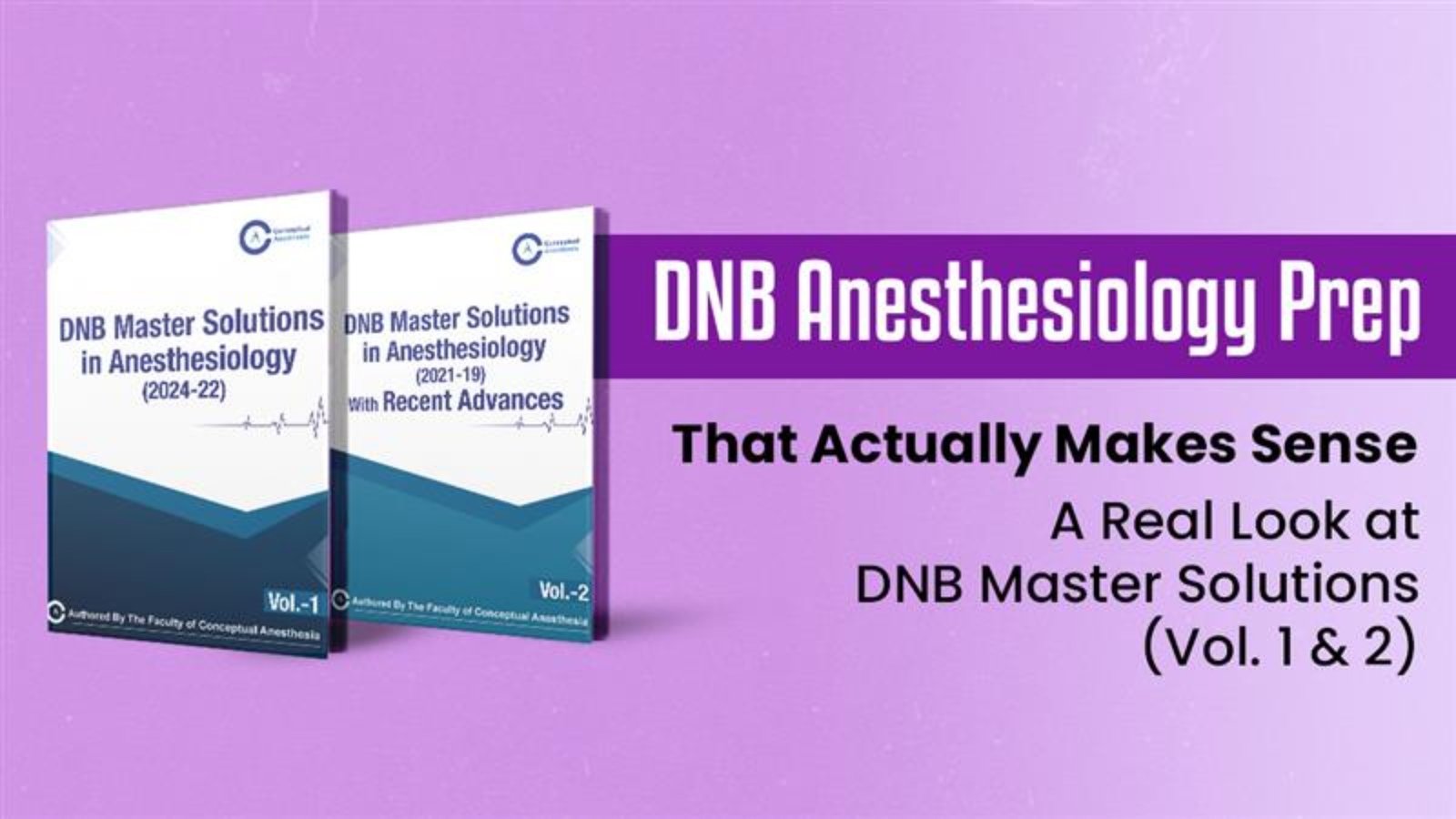
DNB Master Solutions in Anesthesiology 

DNB Master Solutions in Anesthesiology (2024–22) Vol. 1 

This volume is designed around DNB Anesthesiology preparation, with a structured approach to exam format, practice, review, and understanding answers. 

Visit the sample pages to see how the book is structured. 

DNB Master Solutions in Anesthesiology (2021–19) with Recent Advances Vol. 2 

This volume focuses on previous DNB Anesthesiology questions along with recent advances, helping residents practice questions and review their answers systematically. 

Visit the sample pages to explore the book before choosing it for your preparation. 

A Simple Way to Prepare for the Practical 

As your DNB final exam gets closer, don’t limit yourself to just reading through notes. Make your prep more hands-on: 

  • Practice presenting common cases out loud 
  • Go back over important investigations and how to interpret them 
  • Practice answering viva questions in short, clear responses 
  • Talk through anesthetic plans for common clinical situations 
  • Revise previous exam questions 
  • Figure out where your clinical reasoning still needs work 

The more you practice actually explaining your approach out loud, the more naturally it’ll come to you when you’re in front of the examiner. 

The Final Takeaway 

The DNB Anesthesia Practical Exam is ultimately about demonstrating that you can think like a safe and competent clinician. You need to show the examiner that you can assess the patient, identify risks, interpret relevant findings, formulate an anesthetic plan, and communicate your reasoning clearly. 

Do not focus only on predicting what the examiner might ask. 

Focus on understanding why you would make a particular clinical decision and how you would approach the patient in front of you. 

That shift can make your DNB Anesthesia practical preparation more structured, clinically relevant, and useful throughout your PG residency. 

Share

DNB Master Solutions (Vol. 1 & 2)

DNB Anesthesiology Prep That Actually Makes Sense: A Real Look at DNB Master Solutions (Vol. 1 & 2) 

Estimated reading time: 5 minutes

If you’ve spent even a few weeks in Anesthesia residency, you already know this—just reading standard anesthesia books isn’t enough. You go through topics, revise them, maybe even feel confident for a while, but when it comes to writing in the DNB theory exam or structuring answers in the MD Exam or DA Exam, things don’t come out the way you expect. 

That gap is real. And that’s exactly where DNB Master Solutions in Anesthesiology – Volume 1 & Volume 2 by the faculty of Conceptual Anesthesdia start to feel useful—not as another source of study material, but as something that actually helps with exam preparation. 

Volume 1: Recent Papers, Current Pattern (2024–2022) 

Starting with Volume 1—this one feels closest to the actual DNB exam you’re preparing for. 

It covers recent years (2024–22), and you can see the difference. The pattern, the integration, the way questions are asked—it all feels relevant to the current DNB theory format. 

What stands out while using it: 

  • Questions reflect what you’re likely to see in the DNB theory exam  
  • Answers are structured in a way you can reproduce in real exams  
  • It pushes you toward clinical thinking, not just memorization  

If you’re also preparing alongside NEET SS anesthesia or planning ahead for NEET SS exam, this volume aligns well with that level of thinking. 

It’s not complicated reading. You go through an answer once, and it makes sense. That helps more than people realize during heavy neet ss preparation phases. 

Volume 2: Building Depth + Recent Advances (2021–2019) 

Now Volume 2—this one goes a bit older (2021–19), but it plays a different role. 

It helps you slow down a bit and actually understand things properly, especially if you’re early in your anesthesia residency or still figuring out how to approach the DNB theory exam. 

What you’ll notice here: 

  • Slightly more space to build concepts  
  • Better for getting comfortable with answer writing  
  • Includes relevant recent advances without overloading  

For many anesthesia residents, this becomes the starting point. It’s not rushed, and that helps when your base isn’t fully solid yet. 

How to Use These Books? (Without Overcomplicating It) 

Most people try to “complete” books like this. That usually doesn’t work. 

A more practical way: 

  • Try answering first—even if it’s incomplete  
  • Then read the solution and compare  
  • Focus on what you missed (structure matters as much as content)  

Also, don’t ignore timing. Occasionally solving under exam conditions helps with the DNB exam mindset. 

And revision? That’s where this really pays off. The second or third read feels much faster and clearer. 

What Actually Improves Over Time?

If you use both volumes consistently, a few things start changing—not suddenly, but steadily: 

  • Your answers become more structured  
  • You stop writing unnecessary details  
  • You recognize repeated themes across DNB theory and even NEET ss exam patterns  
  • You feel less stuck during long answers  

It’s subtle, but it builds confidence. 

Volume 1 vs Volume 2 — Keep It Simple 

If you’re unsure where to begin, keep it straightforward. 

Start with Volume 1. It reflects the most recent DNB theory exam pattern, so you get used to how questions are currently framed and what the exam expects from your answers. 

Once you’re comfortable with that, move to Volume 2. This helps reinforce your base, gives you more practice with slightly older questions, and strengthens your overall understanding without the pressure of “latest trends.” 

You can examine the sample pages here to quickly obtain a sense of the format, clarity, and question style of both DNB Master Solutions in Anesthesia Volumes 1 and Anesthesia volume 2. 

Final Thought 

Whether it’s the DNB theory exam, MD Exam, DA Exam, or even future NEET SS preparation, the challenge is the same—you need to convert knowledge into answers that score. 

DNB Master Solutions in Anesthesiology – Volume 1 & Volume 2 don’t try to replace your main study material. But they do something equally important—they show you how to apply what you’ve studied. 

And for most anesthesia residents, that’s the part that makes the real difference.

Share

DNB Theory Exam

DNB Theory Exam Success Story: Dr. Nidhi Prasad Got Excellent Marks 237

Estimated reading time: 3 minutes

Hello and welcome! We are thrilled to share the inspiring success of Dr. Nidhi Prasad, who has cleared her DNB Theory Exam with outstanding marks of 237. Congratulations, Nidhi—we are so happy for you!

Dr. Nidhi’s Jouney: Let’s Know About Her

Dr. Nidhi is a third-year DNB Anaesthesia resident at the Main Hospital and Research Centre, Bhilai, which comes under the Bhilai Steel Plant.

She came to know about Conceptual Anesthesia around two years ago, right around the time it was launched. “One of her DNB seniors introduced her to this amazing platform, and since then, it has been helping them tremendously. 

How Nidhi Used the Conceptual Anesthesia App? 
Dr. Nidhi Shared,

“My preparation was primarily through Conceptual Anesthesia, with a few topics from Morgan and Barash. I mainly followed the videos, made detailed notes, and focused on revisions from those notes.

The Short Cases book and the previous year’s questions with solved answers provided on the app were extremely helpful. These two resources really strengthened my preparation.”

Her Favourite Sections and Teachers

While many students love different aspects of the app, Dr. Nidhi highlights the ICU topics as her favourite.

“Almost all the topics in the ICU section were well-covered. For Paper 4, I think I could answer almost every question thanks to the ICU lectures. The Nija sir lectures were also very helpful,” she adds.

Preparing for DNB Practicals

Looking ahead, Nidhi is already gearing up for the next step.

“The tentative dates for the DNB Practicals are around early and late September. Right now, I’m focusing mainly on OSCE as advised by our consultants. I have already watched a few of your previous OSCE sessions, and I’m looking forward to more such sessions in the future.”

For case discussions, Dr. Nidhi plans to:

  • Revisit her notes from the theory preparation.
  • Go through the interactive case discussion videos.
  • Use the Long Cases, Short Cases, and Drugs book provided by Conceptual Anesthesia for comprehensive revision.
A Message of Gratitude

Before signing off, Nidhi expresses her thanks:

“Thank you so much, ma’am. Conceptual anaesthesia has played a huge role in my success. I’m sure it will help me just as much for my practical exams.”

Wishing Nidhi the Best

We at Conceptual Anesthesia are incredibly proud of Dr. Nidhi Prasad and her dedication. We wish her the very best for her upcoming DNB practical exams and look forward to celebrating her next achievement soon.

All the best, Nidhi—you inspire us all!

Share