Dr. Jhanvi Bajaj

DNB June 2026 Paper 1 Discussed By Dr. Jhanvi Bajaj: MAC Question| What Residents Should Revise 

Estimated reading time: 6 minutes

The DNB June 2026 Paper 1 included several questions that were closely aligned with previously asked concepts. One of the recalled questions focused on Minimum Alveolar Concentration (MAC), its definite. 

Let’s break it down the way you would actually revise it before an exam. 

First things first: What exactly is MAC? 

Minimum Alveolar Concentration (MAC) is the minimum alveolar concentration of an inhalational anesthetic at 1 atmosphere pressure that prevents movement in response to a standard surgical incision in 50% of patients. 

That definition can look unnecessarily complicated when you first read it. 

The easiest way to understand it is: 

MAC tells you how much of a volatile anesthetic is needed to prevent movement during surgery in 50% of patients. 

And there is one relationship you should not forget: 

Lower MAC = Higher potency 

Higher MAC = Lower potency 

For example, the MAC of sevoflurane is around 2%, whereas desflurane has a MAC of around 6%. 

So, a lower concentration of sevoflurane is needed to achieve the same endpoint. 

That means: 

Sevoflurane is more potent than desflurane. 

This is why MAC is useful when comparing the potency of inhalational anesthetic agents. 

Important MAC values to revise 

You don’t need to turn this into a memory exercise where you keep staring at numbers for hours. Start by knowing the approximate values and, more importantly, their order. 

Inhalational agent Approximate MAC 
Methoxyflurane 0.16% 
Halothane 0.75% 
Isoflurane 1.4% 
Sevoflurane 2% 
Desflurane 6% 
Nitrous oxide 104% 

Methoxyflurane has a very low MAC, which means high potency. However, it is not commonly used because of its nephrotoxicity. 

For exams, knowing the commonly tested values is more useful than trying to memorise every possible number. 

Factors that decrease MAC 

Now comes the part that is often tested in MCQs and theory questions. 

Think about it this way: 

If the patient is already more sedated or more sensitive to anesthetic effects, you need less volatile anesthetic. 

So MAC goes down. 

Important factors include: 

  • Increasing age 
  • Hypothermia 
  • Hypoxia 
  • Pregnancy 
  • Opioids 
  • Benzodiazepines 
  • Alpha-2 agonists such as dexmedetomidine and clonidine 
  • Acute alcohol intoxication 

A simple revision line: 

Elderly + hypothermia + pregnancy + CNS depressants → ↓ MAC 

Pregnancy 

Pregnancy is a particularly important association. 

The requirement for inhalational anesthetic decreases during pregnancy. Increased progesterone levels are one of the factors associated with this increased sensitivity. 

So, for a quick recall: 

Pregnancy → ↓ MAC 

Acute alcohol vs chronic alcohol: Don’t mix them up 

This is one of those small differences that can easily cost you a mark. 

Acute alcohol intoxication → ↓ MAC 

The patient is already under the sedative effects of alcohol, so less anesthetic is required. 

Chronic alcohol use → ↑ MAC 

With chronic exposure, tolerance develops. The patient is therefore less sensitive to the sedative effects, and the anesthetic requirement increases. 

So remember: 

Acute alcohol = decrease 

Chronic alcohol = increase 

Factors that increase MAC 

Now flip the concept. 

If the patient is more stimulated, has increased metabolic activity, or has developed tolerance to a sedative substance, the anesthetic requirement can increase. 

Important factors include: 

  • Hyperthermia 
  • Hypernatremia 
  • Acute cocaine use 
  • Chronic alcohol use 
  • Chronic amphetamine use 
  • Infancy, particularly around 6 months of age 

Again, don’t just memorise the list. Try to understand the pattern. 

Age and MAC 

Age is an important one. 

MAC is relatively high in infancy and reaches its maximum around 6 months of age. 

After that, it gradually decreases with age. 

So: 

Infant → higher MAC 

Elderly → lower MAC 

This comparison is worth remembering because it can easily appear as an MCQ. 

What does not significantly affect MAC? 

Not every patient characteristic changes MAC. 

The commonly recalled points include: 

  • Gender 
  • Thyroid disease 
  • Duration of anesthesia 

These are useful to remember because they can be used as distractors in exam questions. 

What about the CNS effects? 

The recalled DNB question also asked about the effects of inhalational anesthetic agents on the CNS. 

Volatile anesthetics produce dose-dependent CNS depression. Their effects include changes in: 

  • Consciousness 
  • Memory 
  • Cerebral activity 
  • Immobility 

They can also alter cerebral blood flow and intracranial dynamics, which is why their CNS effects are clinically important rather than being just a theory topic. 

When preparing this part for theory, don’t learn it as a random list. Try to connect each effect with its clinical relevance. 

How should you write this answer in DNB theory? 

If you get a similar question in your exam, don’t start writing everything you remember about inhalational anesthetics. 

Keep the answer organised. 

A simple structure would be: 

1. Definition of MAC 

2. Relationship between MAC and potency 

3. Important MAC values 

4. Factors decreasing MAC 

5. Factors increasing MAC 

6. Factors with little or no effect on MAC 

7. CNS effects of inhalational anesthetics 

This makes your answer easier to follow and also reduces the chance of leaving out one part of a multi-component question. 

Five-minute revision before the exam 

If you are revising MAC at the last minute, ask yourself: 

Can I define MAC in one sentence? 

Can I explain why lower MAC means greater potency? 

Do I remember the approximate MAC of sevoflurane and desflurane? 

What happens to MAC in pregnancy? 

What happens in elderly patients? 

Can I differentiate acute and chronic alcohol use? 

Which drugs decrease MAC? 

Which conditions increase MAC? 

If you can answer these without looking at your notes, your basic MAC revision is in good shape. 

The bigger lesson from this DNB paper 

The important takeaway isn’t just MAC. 

The June 2026 Paper 1 recalls show why residents should not ignore previously asked and repeatedly tested concepts while preparing for DNB theory. 

A topic that looks simple can still become a full-length theory question when the examiner asks for its definition, clinical factors, numerical values and physiological effects together. 

So while revising, don’t just ask: 

“Have I read this topic?” 

Ask: 

“Can I write this topic as a structured answer if it comes in my paper tomorrow?” 

That small change in the way you revise can make your preparation much more exam-oriented. 

Note: This discussion is based on student recalls of the DNB June 2026 Paper 1. The exact question paper was not available at the time of the discussion. 
 
Watch Video: DNB JUNE 2026 – PAPER 1 | MAC Question Discussion | Dr. Jhanvi Bajaj 

Share

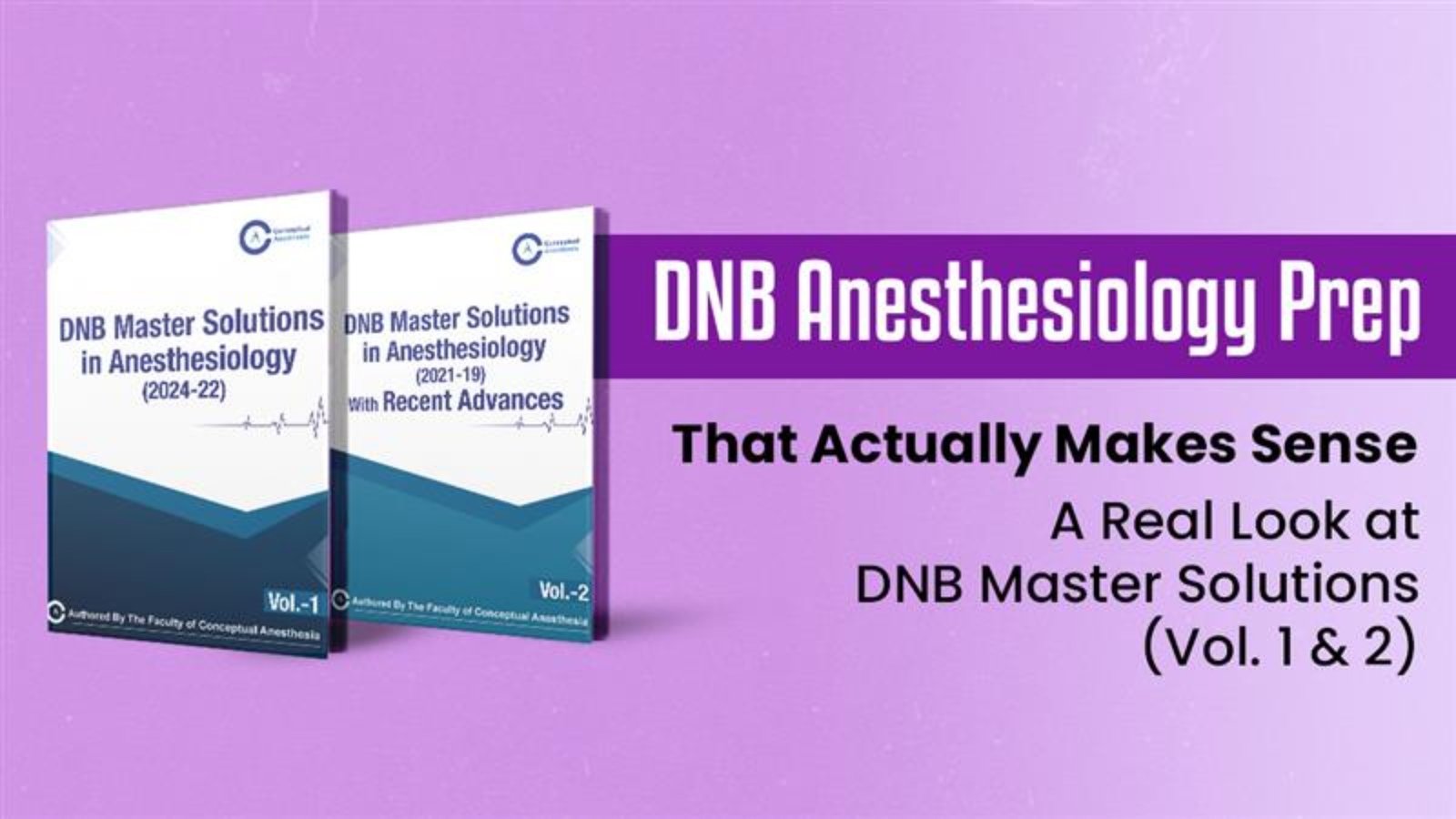
DNB Master Solutions (Vol. 1 & 2)

DNB Anesthesiology Prep That Actually Makes Sense: A Real Look at DNB Master Solutions (Vol. 1 & 2) 

Estimated reading time: 5 minutes

If you’ve spent even a few weeks in Anesthesia residency, you already know this—just reading standard anesthesia books isn’t enough. You go through topics, revise them, maybe even feel confident for a while, but when it comes to writing in the DNB theory exam or structuring answers in the MD Exam or DA Exam, things don’t come out the way you expect. 

That gap is real. And that’s exactly where DNB Master Solutions in Anesthesiology – Volume 1 & Volume 2 by the faculty of Conceptual Anesthesdia start to feel useful—not as another source of study material, but as something that actually helps with exam preparation. 

Volume 1: Recent Papers, Current Pattern (2024–2022) 

Starting with Volume 1—this one feels closest to the actual DNB exam you’re preparing for. 

It covers recent years (2024–22), and you can see the difference. The pattern, the integration, the way questions are asked—it all feels relevant to the current DNB theory format. 

What stands out while using it: 

  • Questions reflect what you’re likely to see in the DNB theory exam  
  • Answers are structured in a way you can reproduce in real exams  
  • It pushes you toward clinical thinking, not just memorization  

If you’re also preparing alongside NEET SS anesthesia or planning ahead for NEET SS exam, this volume aligns well with that level of thinking. 

It’s not complicated reading. You go through an answer once, and it makes sense. That helps more than people realize during heavy neet ss preparation phases. 

Volume 2: Building Depth + Recent Advances (2021–2019) 

Now Volume 2—this one goes a bit older (2021–19), but it plays a different role. 

It helps you slow down a bit and actually understand things properly, especially if you’re early in your anesthesia residency or still figuring out how to approach the DNB theory exam. 

What you’ll notice here: 

  • Slightly more space to build concepts  
  • Better for getting comfortable with answer writing  
  • Includes relevant recent advances without overloading  

For many anesthesia residents, this becomes the starting point. It’s not rushed, and that helps when your base isn’t fully solid yet. 

How to Use These Books? (Without Overcomplicating It) 

Most people try to “complete” books like this. That usually doesn’t work. 

A more practical way: 

  • Try answering first—even if it’s incomplete  
  • Then read the solution and compare  
  • Focus on what you missed (structure matters as much as content)  

Also, don’t ignore timing. Occasionally solving under exam conditions helps with the DNB exam mindset. 

And revision? That’s where this really pays off. The second or third read feels much faster and clearer. 

What Actually Improves Over Time?

If you use both volumes consistently, a few things start changing—not suddenly, but steadily: 

  • Your answers become more structured  
  • You stop writing unnecessary details  
  • You recognize repeated themes across DNB theory and even NEET ss exam patterns  
  • You feel less stuck during long answers  

It’s subtle, but it builds confidence. 

Volume 1 vs Volume 2 — Keep It Simple 

If you’re unsure where to begin, keep it straightforward. 

Start with Volume 1. It reflects the most recent DNB theory exam pattern, so you get used to how questions are currently framed and what the exam expects from your answers. 

Once you’re comfortable with that, move to Volume 2. This helps reinforce your base, gives you more practice with slightly older questions, and strengthens your overall understanding without the pressure of “latest trends.” 

You can examine the sample pages here to quickly obtain a sense of the format, clarity, and question style of both DNB Master Solutions in Anesthesia Volumes 1 and Anesthesia volume 2. 

Final Thought 

Whether it’s the DNB theory exam, MD Exam, DA Exam, or even future NEET SS preparation, the challenge is the same—you need to convert knowledge into answers that score. 

DNB Master Solutions in Anesthesiology – Volume 1 & Volume 2 don’t try to replace your main study material. But they do something equally important—they show you how to apply what you’ve studied. 

And for most anesthesia residents, that’s the part that makes the real difference.

Share

Dr. Jhanvi Bajaj

LMA Types Explained for PDCET & DNB Exams: First vs Second Generation LMA by Dr. Jhanvi Bajaj 

Estimated reading time: 6 minutes

Airway management is an important topic in anesthesia, and Laryngeal Mask Airways (LMAs) are frequently asked about in exams like PDCET and DNB. In this session, Dr. Jhanvi Bajaj explains the different types of LMAs, how to identify them, and the key exam points you should remember. 

Let’s go through them step by step. 

First Generation LMAs 

Let’s start with the first generation LMAs. 

They are called first generation because they have only a single tube coming out of them. This single tube is the airway tube. 

Since these LMAs do not have a separate gastric drainage tube, they are prone to the risk of aspiration. They also do not create a strong seal with the larynx, which is why they are not preferred in many situations today. 

However, you must still be able to identify them in exams. 

LMA Classic 

The first LMA you may see is the LMA Classic. 

Features include: 

  • A silicon cuff 
  • A pilot balloon used to inflate the cuff 
  • A single airway tube 

This is the classic reusable LMA. 

LMA Unique 

Now imagine an LMA that looks similar to the LMA Classic, but it is disposable. 

This one is made of PVC material, which means it is designed for single use. 

You use it once and discard it, and this LMA is called LMA Unique. 

Important Exam Point 

A common exam question is: 

How many times can silicon-based LMAs be reused? 

The answer is up to 40 times. 

The method of sterilization used for LMAs is autoclaving. 
So the sequence is: 

  1. Wash the LMA 
  1. Sterilize it using autoclaving 
LMA Flexible 

Another important LMA for exams is the LMA Flexible. 

It is commonly used in: 

  • Head and neck surgeries 
  • Intraoral surgeries 
  • Neurosurgeries 
  • Situations where the patient may be in the prone position 

This LMA is still first generation, because it has only one tube. 

How do you identify it? 

Inside the tube, you will notice small metallic wirings. These wires allow the LMA to bend at different angles without kinking the lumen. 

Because of this flexibility, it is very useful when the airway needs to be shared with the surgeon. 

Second Generation LMAs 

Now let’s move to second -generation LMAs. 

The major difference is simple: 

Second generation LMAs have two tubes. 

These include: 

  • A large airway tube used for ventilation 
  • A smaller gastric drainage tube 

The gastric drainage tube allows insertion of a Ryle’s tube, which helps remove gastric or esophageal contents. This significantly reduces the risk of aspiration. 

Other parts you may notice include: 

  • Fixation tab – helps secure the LMA at the teeth 
  • Bite block – prevents damage to the LMA if the patient bites during recovery from anesthesia 

If the LMA is made of transparent PVC material, it usually means it is single-use. 

LMA Supreme 

One of the most commonly used LMAs is the LMA Supreme. 

Features include: 

  • Two tubes (airway + gastric) 
  • Transparent PVC material 
  • Disposable design 

Because of these features, it is widely used in clinical practice. 

LMA ProSeal 

Another very important LMA is the LMA ProSeal. 

This LMA: 

  • Has two tubes 
  • Is made of silicon material 
  • Is reusable 

Since it is silicon-based, it can be autoclaved and reused up to 40 times. 

LMA ProSeal is one of the most commonly used LMAs worldwide. 

It is especially preferred for: 

  • Daycare anesthesia 
  • Laparoscopic surgeries 
Ambu LMAs 

Next are LMAs manufactured by the Ambu company. 

These are usually colored LMAs, which helps in identifying them. 

Ambu Aura 40 

The Ambu Aura 40 is a first generation LMA. 

How do you identify it? 

Just check the number of tubes: 

  • One tube → First generation 

The name Aura 40 comes from the fact that it can be reused up to 40 times after sterilization. 

Ambu Aura Gain 

Another LMA from the same company is Ambu Aura Gain. 

This LMA has: 

  • One airway tube 
  • One gastric tube 

So it clearly belongs to the second generation LMAs. 

A simple way to remember it is: 

Ambu Aura Gain = Ambu Aura Green 

Since the LMA is green in color, it becomes easy to recall the name. 

I-gel LMA 

Another very important LMA for exams is the I-gel LMA. 

You can identify it easily because there is no pilot inflation balloon. 

So the obvious question is: 

How does the cuff inflate? 

The answer is that I-gel is made of thermo-elastic material. 

When inserted into the airway, this material responds to body temperature, expands slightly, and creates a seal around the laryngeal structures. 

Because of this property: 

  • No cuff inflation is required 
  • There is no pilot balloon 

So if the exam asks: 

Which LMA is a second generation cuffless LMA? 

The answer is I-gel LMA. 

Quick Revision 

Here’s a quick recap: 

First Generation LMAs 

  • LMA Classic 
  • LMA Unique 
  • LMA Flexible 
  • Ambu Aura 40 

Second Generation LMAs 

  • LMA Supreme 
  • LMA ProSeal 
  • Ambu Aura Gain 
  • I-gel LMA 

The easiest way to identify them in exams is to count the number of tubes: 

  • One tube → First generation 
  • Two tubes → Second generation 

Understanding the different types of LMAs and how to identify them is extremely important for exams like PDCET and DNB. Many questions are image-based, so simply remembering the number of tubes, material used, and special identifying features can help you quickly pick the right answer. If you focus on these small but important details, revising LMAs becomes much easier and far less confusing during exam preparation. 

If you want clearer, exam-oriented explanations of anesthesia topics, make sure to subscribe to Conceptual Anesthesia. Stay connected for more high-yield sessions. quick revisions, and practical exam tips that will help you prepare smarter for your upcoming exams. 

Share

Anesthesia Residents

Master’s Degrees in Anaesthesia After MBBS in India: MD, DNB, and DA

Estimated reading time: 4 minutes

Anaesthesia is often misunderstood. Many people think it’s only about putting patients to sleep before surgery. Anyone who has spent even a few days in an operating theatre or ICU knows that this couldn’t be further from the truth.

The Anesthesia branch is about vigilance, judgment, and responsibility. When things go wrong during surgery or in the ICU, the anaesthesiologist is usually the first one expected to act—and act fast.

If you’re an MBBS graduate considering Anaesthesia for postgraduation, it’s important to understand what degrees are available in India and what kind of future they actually offer. Let’s talk about this honestly, without exaggeration.

MD (Doctor of Medicine) in Anesthesiology

MD – Doctor of Medicine in Anesthesiology is the most commonly pursued postgraduate degree in Anaesthesia in India. It is a three-year course conducted in medical colleges recognised by the National Medical Commission (NMC).

MD Anaesthesiology training is intense. You don’t just learn drugs and doses—youknown how to manage airways, unstable vitals, emergency situations, and critically ill patients. A large part of your residency is spent inside operating theatres and Intensive Care Units.

Over time, you start understanding that Anaesthesia is less about routine work and more about preparedness. Every case is different, and that’s what keeps the branch challenging.

Scope After MD (Doctor of Medicine) Anaesthesiology

After completing MD Anesthesia, most doctors work as consultant anaesthesiologists in hospitals. Many also choose to:

  • Work predominantly in ICUs
  • Take up senior residency and later teaching roles.
  • Pursue further training in critical care or pain medicine.

MD Anaesthesia offers strong job stability. Surgical services are expanding across India, and anesthesiologists are needed everywhere—from small nursing homes to large corporate hospitals.

DNB (Diplomate of National Board) in Anaesthesia

DNB – Diplomate of National Board in Anaesthesia is awarded by the National Board of Examinations (NBE). Like MD, it is a three-year postgraduate program and is well recognised across the country.

DNB training usually happens in large hospitals rather than traditional medical colleges. This often means heavier workloads and greater clinical responsibility early on. Many DNB residents gain excellent hands-on experience because of this exposure.

In real-world practice, the difference between MD and DNB matters far less than how confident and competent you are clinically.

Scope After DNB (Diplomate of National Board) Anaesthesia

After DNB Anaesthesia, doctors can:

  • Work as consultants in private and corporate hospitals
  • Join trauma centres and ICUs
  • Enter academics after fulfilling eligibility norms.
  • Go on to do fellowships or super-specialisation

Today, DNB Anaesthesia is widely accepted, and most hospitals value skill and experience over the name of the degree.

DA (Diploma in Anesthesia): What You Should Know

DA – Diploma in Anesthesia was a two-year postgraduate diploma that existed earlier. Over the years, this course has been largely phased out, with MD and DNB becoming the standard options.

Doctors who already have a DA degree continue to practice successfully, especially with experience. However, for new aspirants, MD or DNB Anaesthesia is the recommended route.

What Can You Do After Postgraduate Anaesthesia?

Many anaesthesiologists choose to specialise further once they complete their postgraduate degree. Some common paths include:

  • Critical Care Medicine
  • Pain Medicine
  • Cardiac Anaesthesia
  • Neuro-Anaesthesia
  • Paediatric Anaesthesia

These areas allow doctors to focus on specific interests and often come with higher responsibility and expertise-based roles.

Final Words: 

Choosing between MD (Doctor of Medicine) Anaesthesiology and DNB (Diplomate of National Board) Anaesthesia is important, but choosing Anaesthesia itself is the bigger decision. Both degrees offer strong careers, steady demand, and long-term security in India.

If you’re willing to take on responsibility when it matters most, Anaesthesia can be one of the most rewarding medical careers you’ll ever choose.

Share