Dr. Jhanvi Bajaj

Ketamine: The “Agent of Choice” You Must Remember for PDCET Anesthesia Preparation 

When it comes to anesthesia viva questions and clinical scenarios in PDCET exams, one drug that repeatedly shows up is ketamine. Not just because of its mechanism, but because of the number of situations where it becomes the agent of choice. 

In a recent high-yield session, Dr. Jhanvi Bajaj explained the important clinical uses of ketamine and why anesthesiologists prefer it in emergency and special situations. 

What Makes Ketamine Different? 

Ketamine produces something known as dissociative anesthesia. This means the patient may appear disconnected from the surroundings while still technically remaining conscious. 

Unlike many other anesthetic agents that depress respiration and circulation, ketamine behaves differently — and that is exactly why it becomes extremely important in critical cases. 
 
Watch Video: PDCET SPECIAL: Agent of Choice in Clinical Use Cases | Anesthesia Residency Prep by Dr. Jhanvi Bajaj 

Why is Ketamine the Agent of Choice in Shock? 

In patients with shock, maintaining blood pressure is crucial. 

Most anesthetic drugs tend to lower blood pressure, which can worsen the patient’s condition. Ketamine, however: 

  • Increases heart rate  
  • Increases blood pressure  
  • Maintains hemodynamic stability  

Because of this cardiovascular support, ketamine becomes the preferred induction agent in shocked patients. 

Why is Ketamine Preferred in Asthma? 

One of the biggest advantages of ketamine is its bronchodilator action. 

In asthmatic patients, airways are already constricted. Ketamine helps by relaxing the bronchial muscles and improving airflow. 

That is why it is considered the agent of choice in bronchial asthma, especially during emergency procedures. 

Role of Ketamine in Postpartum Hemorrhage (PPH) 

Postpartum hemorrhage is a life-threatening emergency where rapid bleeding control is essential. 

Ketamine is useful because it helps in: 

  • Uterine contraction  
  • Reducing ongoing bleeding  
  • Maintaining blood pressure simultaneously  

This combination makes it highly valuable in obstetric emergencies. 

Why Pediatric Patients Tolerate Ketamine Better?

Children often react strongly to painful IV injections. 

Drugs like propofol and etomidate can cause pain during injection, making pediatric induction difficult. Ketamine offers a smoother alternative. 

It helps because: 

  • It does not cause painful induction  
  • Children tolerate it better  
  • It allows easier transition to inhalational anesthesia later  

This makes anesthesia induction less traumatic for pediatric patients. 

Ketamine in Full Stomach Patients & Obstetrics 

In full stomach patients, the fear is always aspiration. 

Ketamine is preferred because it preserves protective airway reflexes. Even if regurgitation occurs, the airway reflexes remain active and help prevent aspiration into the lungs. 

This is particularly useful in: 

  • Emergency surgeries  
  • Obstetric anesthesia  
  • Trauma settings  
Why Ketamine is Used in War Zones and Field Anesthesia?

One of the most practical uses of ketamine is in battlefield or trauma settings. 

Imagine a patient with severe trauma who requires: 

  • Pain relief  
  • Minor procedures  
  • Suturing or bandaging  

Ketamine becomes ideal because: 

  • It provides strong analgesia  
  • It maintains spontaneous respiration  
  • It supports circulation  

In places where ventilators and advanced monitoring may not be available, this drug becomes extremely reliable. 

Ketamine in Cyanotic Congenital Heart Disease 

This is one of the most important conceptual questions for exams. 

In cyanotic congenital heart disease, there is usually a right-to-left shunt, meaning deoxygenated blood bypasses the lungs and enters systemic circulation. 

Ketamine helps because it: 

  • Increases systemic vascular resistance (SVR)  
  • Reduces the right-to-left shunt  
  • Improves oxygenation  

That is why anesthesiologists prefer ketamine in these cardiac patients. 

Ketamine for Short Painful Procedures 

For quick painful procedures like: 

  • Dressing changes  
  • Minor suturing  
  • Manipulations  
  • Emergency bedside procedures  

Ketamine works extremely well due to its: 

  • Strong analgesic effect  
  • Sedation  
  • Respiratory stability  
High-Yield Exam Point to Remember 

If a clinical scenario mentions: 

  • Shock  
  • Asthma  
  • Trauma  
  • Pediatric induction  
  • Cyanotic heart disease  
  • Emergency field anesthesia  

…ketamine should immediately come to your mind. 

These are classic “agent of choice” situations frequently asked in anesthesia entrance exams and residency discussions. 

For anesthesia residents and PDCET aspirants, understanding why ketamine is preferred is far more important than simply memorizing the list. 

Because once the concept is clear, clinical questions become much easier to solve. 

Conclusion: 

If you want more high-yield anesthesia discussions like this for PDCET and residency preparation, then Conceptual Anesthesia is the place to be. 

From clinically relevant concepts to agent-of-choice discussions, rapid revision sessions, and exam-focused teaching — every session is designed to help residents and aspirants build strong conceptual clarity. 

Subscribe to Conceptual Anesthesia and start preparing with expert guidance from experienced faculty who simplify even the most confusing anesthesia topics into easy-to-remember clinical concepts. 

Thousands of residents are already learning smarter with Conceptual Anesthesia — now it’s your turn to level up your preparation. 

Share

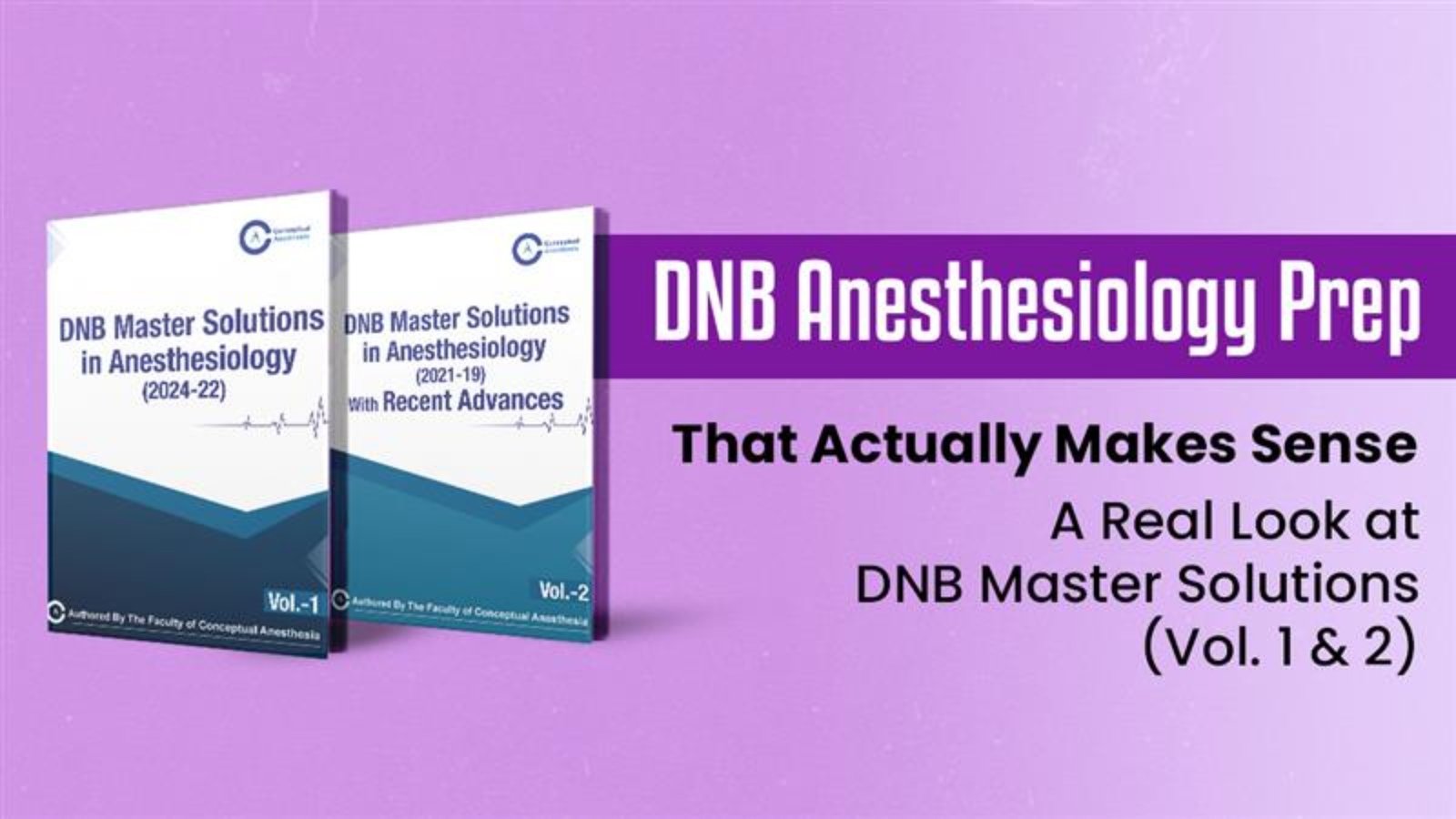
DNB Master Solutions (Vol. 1 & 2)

DNB Anesthesiology Prep That Actually Makes Sense: A Real Look at DNB Master Solutions (Vol. 1 & 2) 

Estimated reading time: 5 minutes

If you’ve spent even a few weeks in Anesthesia residency, you already know this—just reading standard anesthesia books isn’t enough. You go through topics, revise them, maybe even feel confident for a while, but when it comes to writing in the DNB theory exam or structuring answers in the MD Exam or DA Exam, things don’t come out the way you expect. 

That gap is real. And that’s exactly where DNB Master Solutions in Anesthesiology – Volume 1 & Volume 2 by the faculty of Conceptual Anesthesdia start to feel useful—not as another source of study material, but as something that actually helps with exam preparation. 

Volume 1: Recent Papers, Current Pattern (2024–2022) 

Starting with Volume 1—this one feels closest to the actual DNB exam you’re preparing for. 

It covers recent years (2024–22), and you can see the difference. The pattern, the integration, the way questions are asked—it all feels relevant to the current DNB theory format. 

What stands out while using it: 

  • Questions reflect what you’re likely to see in the DNB theory exam  
  • Answers are structured in a way you can reproduce in real exams  
  • It pushes you toward clinical thinking, not just memorization  

If you’re also preparing alongside NEET SS anesthesia or planning ahead for NEET SS exam, this volume aligns well with that level of thinking. 

It’s not complicated reading. You go through an answer once, and it makes sense. That helps more than people realize during heavy neet ss preparation phases. 

Volume 2: Building Depth + Recent Advances (2021–2019) 

Now Volume 2—this one goes a bit older (2021–19), but it plays a different role. 

It helps you slow down a bit and actually understand things properly, especially if you’re early in your anesthesia residency or still figuring out how to approach the DNB theory exam. 

What you’ll notice here: 

  • Slightly more space to build concepts  
  • Better for getting comfortable with answer writing  
  • Includes relevant recent advances without overloading  

For many anesthesia residents, this becomes the starting point. It’s not rushed, and that helps when your base isn’t fully solid yet. 

How to Use These Books? (Without Overcomplicating It) 

Most people try to “complete” books like this. That usually doesn’t work. 

A more practical way: 

  • Try answering first—even if it’s incomplete  
  • Then read the solution and compare  
  • Focus on what you missed (structure matters as much as content)  

Also, don’t ignore timing. Occasionally solving under exam conditions helps with the DNB exam mindset. 

And revision? That’s where this really pays off. The second or third read feels much faster and clearer. 

What Actually Improves Over Time?

If you use both volumes consistently, a few things start changing—not suddenly, but steadily: 

  • Your answers become more structured  
  • You stop writing unnecessary details  
  • You recognize repeated themes across DNB theory and even NEET ss exam patterns  
  • You feel less stuck during long answers  

It’s subtle, but it builds confidence. 

Volume 1 vs Volume 2 — Keep It Simple 

If you’re unsure where to begin, keep it straightforward. 

Start with Volume 1. It reflects the most recent DNB theory exam pattern, so you get used to how questions are currently framed and what the exam expects from your answers. 

Once you’re comfortable with that, move to Volume 2. This helps reinforce your base, gives you more practice with slightly older questions, and strengthens your overall understanding without the pressure of “latest trends.” 

You can examine the sample pages here to quickly obtain a sense of the format, clarity, and question style of both DNB Master Solutions in Anesthesia Volumes 1 and Anesthesia volume 2. 

Final Thought 

Whether it’s the DNB theory exam, MD Exam, DA Exam, or even future NEET SS preparation, the challenge is the same—you need to convert knowledge into answers that score. 

DNB Master Solutions in Anesthesiology – Volume 1 & Volume 2 don’t try to replace your main study material. But they do something equally important—they show you how to apply what you’ve studied. 

And for most anesthesia residents, that’s the part that makes the real difference.

Share

Anesthesia Books

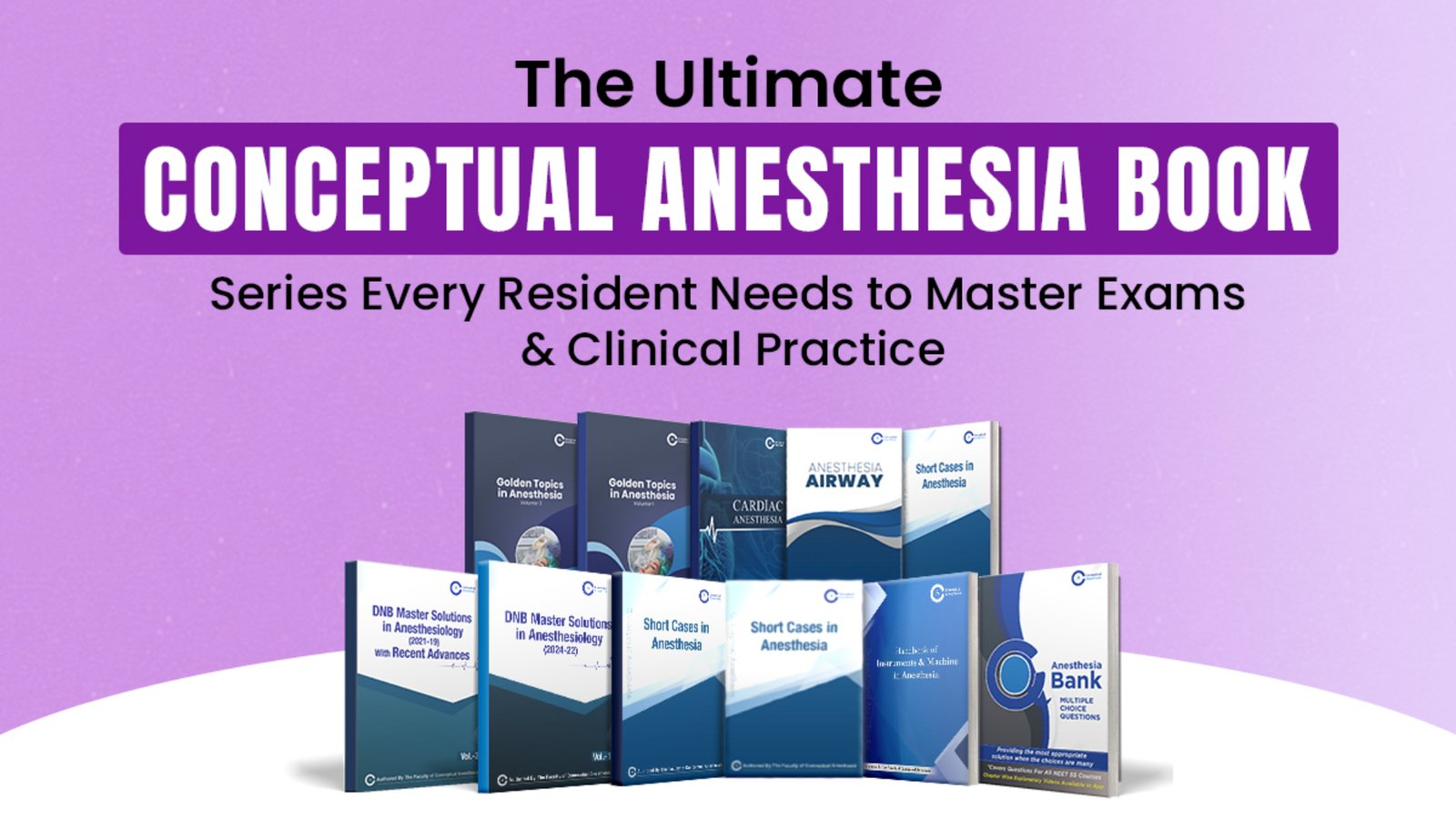
The Ultimate Conceptual Anesthesia Book Series Every Resident Needs to Master Exams and Clinical Practice 

Estimated reading time: 4 minutes

When it comes to mastering anesthesia, the right combination of concepts, clinical exposure, and revision tools can make all the difference. Dr. Apurv Mehra from Team eConceptual gives highlights on one of the most refined and thoughtfully designed learning ecosystems Conceptual Anesthesia, which is built with exactness, passion, and with purpose. 

Conceptual Anesthesia is actually stands out for its well-structured content, which is expertly verified material, important lectures, students can experience practical demonstrations, and detailed notes. But what truly highlights this platform is its ability to impact the lives of residents who are highly depend on it during their most crucial learning phase. 

At the heart of this unique transformation is a powerful collection of books which is organized under the guidance of Dr. Jhanvi Bajaj, who has meticulously developed this series with deep dedication and academic excellence. 

Watch the whole video from here

The Books That Redefine Anesthesia Learning 
1. Airway Book – Mastering the Most Critical Skill 

Airway management is one of the most essential aspects of anesthesia and critical care. This book clarifies a complex topic into clear, structured concepts that are easy to grab and apply.  

  • Covers airway anatomy, procedures, and instrumentation in detail  
  • These books features beautiful diagrams for visual clarity  
  • Although it explains the normal vs. difficult airway scenarios  
  • It provides the step-by-step procedural for better understanding  

This book is not particularly for exams—it becomes a long-term clinical companion, which is helping you to build confidence in real-life situations where the airway management can save lives. 

3. Golden Topics in Anesthesia (Volume 1 & 2) – Your Exam Power Tool 

When it comes to exams, knowing what not to write is just as important as knowing what to write. These two volumes are designed precisely for that purpose. 

  • Focus on complex, must-know topics  
  • It is highly based on the Pareto principle which learn 20% to score 80%  
  • It has highly Includes key points, viva questions, and other important concepts  
  • These are highly ideal for quick revision before DNB, MD, or diploma exams  

These books act as a last minute revision toolkit, which make sure that you don’t miss the crucial points which examiners look for. 

A Collaborative Effort of Excellence 

While Dr. Jhanvi Bajaj leads this incredible initiative, the series is strengthened by contributions from dedicated educators like Dr. Vinisha, Dr. Diya, Dr. Gargi, and Dr. Sohini Ghosh. Each has brought their expertise to different sections, making this collection comprehensive and reliable. 

Why This Book Series Stands Out?

You know, what makes these books truly special? is their balance as they are concept-rich yet very concise, clinically relevant yet highly exam-focused, and easy to revise for exam. They don’t overwhelm you; instead, they will guide you strategically through your preparation. 

Final Thoughts 

However, If you’re also an anesthesia resident who are aiming to excel in both exams and clinical practice, then this book series is more than just a resource as it’s a roadmap to success. With very highly structured learning, visual clarity, and important content, Conceptual Anesthesia books are undoubtedly among the best companions you can have during your journey. 

Share

Anesthesia Residency

Why Should New JRs Join for Conceptual Anesthesia? 

Estimated reading time: 3 minutes

Starting your Anesthesia Residency is a breathtaking step to a wholesome career. But with the anesthesia field being so demanding, nothing else matters more than the availability of the right resources and guidance. Conceptual Anesthesia provides one-stop solutions for all your academic and practical needs. With a combination of detailed study materials, live mentor sessions, and several live practice sessions, Conceptual Anesthesia ensures that you are well-equipped to thrive in the best Anesthesia Residencies.

This is how Conceptual Anesthesia would fit you better through your residency:

1. Clinical Examination and Demonstration

Mastering clinical skills is vital for every anesthesia resident. Conceptual Anesthesia provides detailed clinical examination guides and demonstrations to help you excel in practical scenarios. These sessions prepare you for real-world challenges faced by anesthesia residents.

2. Notes and Discussion on Theory

Conceptual Anesthesia is well crafted by expert faculty. These resources target the anesthesia residency programs and make even the most difficult concepts smoothly assimilate.

3. DNB OSCE Classes

If you’re preparing for DNB exams, our OSCE sessions are a game-changer. Designed by experts, these sessions provide practical insights and tips to excel in objective structured clinical examinations, a crucial component of top anesthesiology residency programs.

4. Conceptual Anesthesia Books-Hard Copy

Conceptual Anesthesia offers an exclusive set of 7 books created by the expert faculty. These anesthesia books provide high-quality material on every important concept and should be part of every anesthesia residency. 

Also Read: Do’s & Don’ts for your 1st, 2nd & 3rd Year of Residency

5. Live sessions by Legendary Faculty

You will learn from the legends of anesthesiology! Our live sessions cover important and rare cases, giving you an edge in understanding these pivotal cases in any discussions occurring in anesthesia residency programs.

6. Solved DNB OSCE Papers and MCQ Practice

Ace your residency exams with the help of solved question papers and an exhaustive question bank for SS exams. These resources are perfect for anesthesia residents aiming for top scores in competitive exams.

7. Interactive MCQ Discussions

MCQ discussion engages you in a very interactive way, sharpens your mind, and pinpoints weak areas. Sessions are held specifically to the needs of anesthesia residency programs for effective medical practice in preparation for SS exams.

8. Pearls for High Yield Revision

With Conceptual Anesthesia, residents get quick revision tricks, like high-yield pearls, to help retain what is critical. This feature has great benefits for residents preparing to give their best in competitive exams for the best anesthesia residencies.

Conclusion:

Conceptual Anesthesia bridges the gap between learning and practice, making it the perfect partner for every anesthesia resident aiming to excel in their field.

Also Read: Why Choose a Career as an Anesthesiologist?

Are you ready to step your residency experience up to the next level? Join Conceptual Anesthesia App, and develop the foundation for a successful career in anesthesiology! 


Share

Anesthesia Residents

Best Anesthesia Resources: Guide for Indian Anesthesiologists

Estimated reading time: 4 minutes

Do you just start your anesthesia residency journey or seek to enhance your skills as an anesthetist in India? Then, look no further. This guide is comprehensive, highlighting the top available resources for anesthesia residents and practitioners within the Indian context. Whether high-quality anesthesia residency programs or the most valuable learning resources, we’ve got you covered.

Excellence in India: Best Anesthesia Residencies

Choosing the right course is an essential step for would-be anesthesiologists. Some of the best anesthesia residencies in India undertake hands-on experience, an expert mentorship, and the latest facilities. Such programs are:

  1.  All India Institute of Medical Sciences New Delhi, 
  2. Postgraduate Institute of Medical Education and Research (PGIMER) Chandigarh, 
  3. Christian Medical College (CMC), Vellore, 
  4. Seth G.S. Medical College and KEM Hospital, Mumbai, and 
  5. Jawaharlal Institute of Postgraduate Medical Education & Research JIPMER, Puducherry.

These colleges offer outstanding academic training, and one can always hone their expertise with unique research in the Indian healthcare system.

Visual Learning: Anesthesia Videos and Training

In the internet age, anesthesia videos are unavoidable for the proper learning of complex procedures and techniques. While there are loads of international resources, there are some excellent India-specific ones too:

  • Indian Society of Anaesthesiologists (ISA) e-learning platform
  • Virtual Anesthesiology (VA) by AIIMS
  • Anesthesia Educational Videos by Indian College of Anesthesiologists

These anesthesia tutorial videos vary from the basics to the advanced techniques in anesthesiology training; thus, very suitable for either a beginner or seasoned practitioner in the Indian context.

Also Read: Emerging Technologies and Innovative Methods in Anesthesia  Residency Program

Knowledge on Your Finger Tips: Must Read Anesthesia Books

No anesthesia residency is ever complete without a strong foundation in literature. In this regard, here’s a cut selection of anesthesia books for residency any aspiring Indian anesthesiologist should have considered:

  1. “Textbook of Anaesthesia” by G. P. Dureja
  2. “Principles of Anaesthesia Equipment” by Yogesh Chauhan
  3. “Self Assessment & Review of Anesthesiology” by Rashmi Datta

These books provide extensive knowledge uniquely designed for Indian medical education systems and are always recommended as the best books for anaesthesia PG students in India.

If the student is a fresher, then one can come across the following best anaesthesia books for medical students:

  1. “Fundamentals of Anaesthesia” by Shamshad Begum
  2. “G. Edward Morgan, Clinical Anesthesiology (Adapted for Indian readers)
  3. “Review of Anesthesiology”, by Pradeep K. Jain
The Conceptual Anesthesia Advantage

Traditional resources galore, but anesthesiology, after all, is constantly changing. Conceptual Anesthesia powered by eConceptual bridges this gap in that sense. Our website gives the model or learning that is focused essentially on the core concepts with practical applications in the Indian healthcare context.

Conceptual Anesthesia offers:
  • Interactive case studies relevant to the scenario under which most hospitals in India currently find themselves
  • Conceptual framework of complex topics applicable to the curriculum standards of medical education in India
  • Latest updates on research and techniques, with guidelines specific to the Indian scenario

By integrating Conceptual Anesthesia into your study routine, you’ll gain a deeper understanding of anesthesiology principles, making you better prepared for your residency and future practice in India.

Conclusion: Your Road to Success in Indian Practice of Anesthesiology

For any beginner, these resources will guide the journey through the Indian health system. For the seasoned practitioner looking to stay updated, success in anesthesiology depends on continuous learning and practical application of knowledge with the unique challenges and opportunities India offers.

Also Read: The Road to Success for the Anesthesia Resident: Tips and Resources to Thrive in Anesthesia Residency

Want to grow your anesthesiology skills? Start learning more about conceptual anesthesia today. Get in touch with us and discover how our new learning platform can support your Indian studies, and ultimately, enrich your practice. Learn anesthesiology and become a master at it with Conceptual Anesthesia!

Start Your Indian Anesthesiology journey with Conceptual Anesthesia App Today!

Share